
Blockchain technology has matured rapidly over the past few years. Infrastructure has improved, transaction speeds have increased, and institutional capital continues to enter the ecosystem. Yet one critical problem remains unresolved: most Web3 products are still too difficult for ordinary users to start using.
The gap between Web2 usability and Web3 interaction models continues to slow adoption. Studies show that more than 70% of users abandon crypto applications during the onboarding stage, often due to wallet setup complexity, gas fees, and confusing transaction processes (Source: Consensys Web3 User Survey).
This reveals a fundamental insight: the largest barrier to Web3 growth is not blockchain technology itself but the friction within Web3 user experience. Designing effective Web2 to Web3 onboarding therefore requires a strategic approach that balances decentralization with usability. The companies that succeed in this transition are those that design onboarding flows that feel as simple as Web2 products while still preserving the core advantages of Web3.
Why Web2 to Web3 Onboarding Fails in Most Web3 Products
For traditional internet users, interacting with Web3 applications often introduces unfamiliar steps that feel unnecessarily complex.
Typical onboarding flows require users to:
- Install a crypto wallet
- Secure a seed phrase
- Understand gas fees
- Approve blockchain transactions
- Bridge assets across networks
Each of these steps introduces cognitive friction. When combined, they create an onboarding experience that feels dramatically more complicated than Web2 platforms.
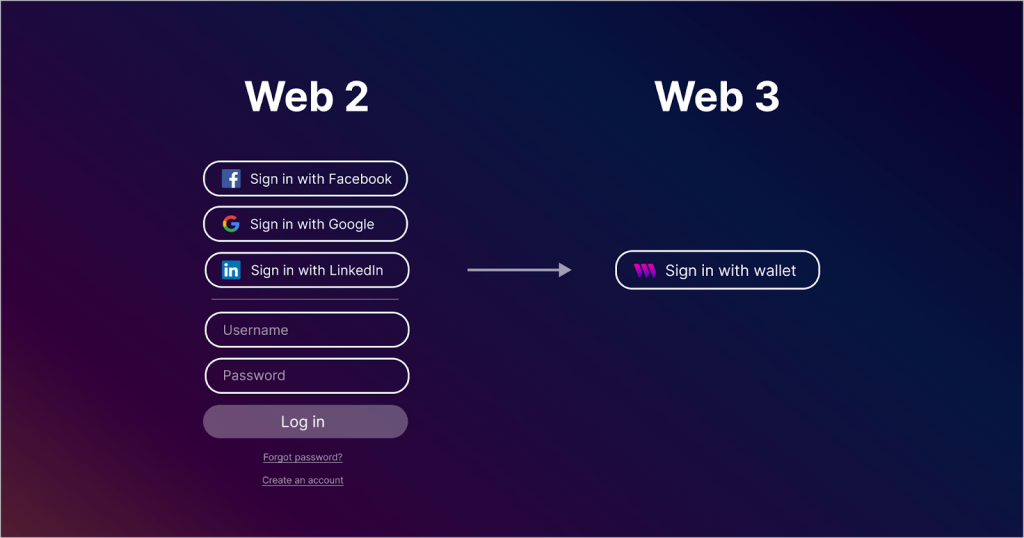
Comparison between traditional Web2 authentication methods and wallet-based login used in Web3 applications (Source: WalletConnect Documentation)
A report from Electric Capital’s Developer Ecosystem Report highlights that while the number of blockchain developers has grown significantly, user growth has lagged behind infrastructure development. One major reason is that Web3 interfaces still assume users possess a level of technical knowledge most mainstream consumers do not have.
Research from DappRadar also shows that a large portion of new users drop off before completing their first transaction. The friction typically appears in three areas:
- Wallet creation complexity
- Gas fee uncertainty
- Transaction confirmation anxiety
These problems do not stem from blockchain limitations. Instead, they arise from poorly designed Web3 user experience layers. Successful Web2 to Web3 onboarding therefore focuses less on adding new blockchain features and more on removing unnecessary interaction barriers.
The New Architecture Behind Successful Web2 to Web3 Onboarding
The most effective Web3 products today no longer expose blockchain complexity directly to users. Instead, they introduce architectural layers that abstract wallets, gas fees, and transaction logic.
This approach allows decentralized applications to deliver a Web2-like experience while still operating on blockchain infrastructure, which is essential for scalable Web2 to Web3 onboarding.
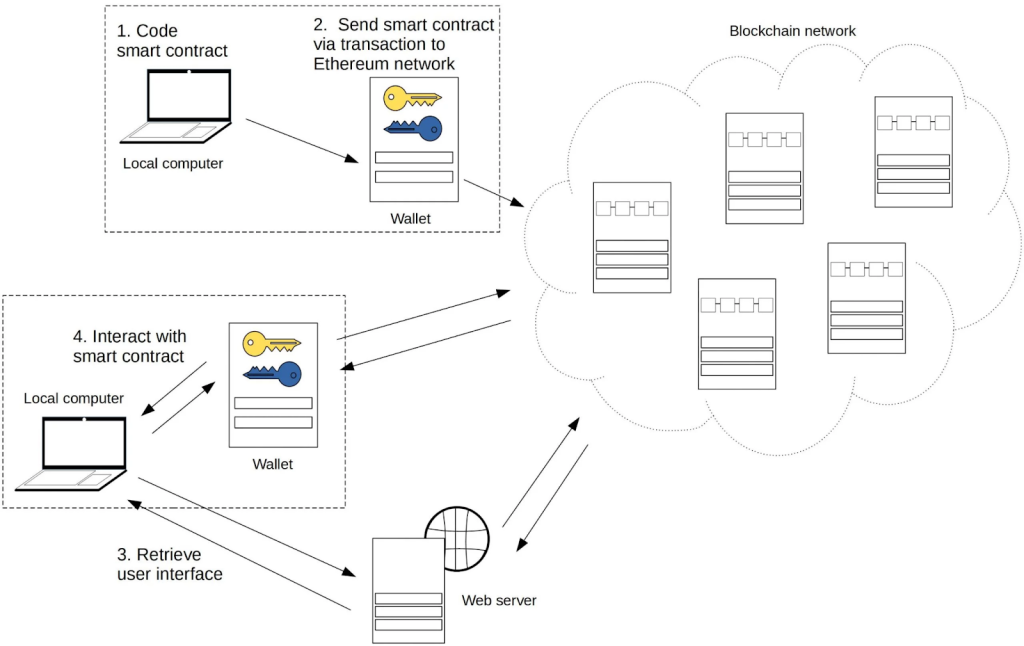
Typical Web3 interaction flow showing how users connect wallets, interact with smart contracts, and communicate with blockchain networks (Source: Ethereum Developer Documentation)
1. Account Abstraction Simplifies Wallet Interactions
Traditional wallets require users to manage private keys and sign every transaction manually. This model creates significant friction for mainstream users.
Account abstraction (EIP-4337) introduces smart contract wallets that can automate many wallet operations, including:
- Transaction batching
- Automated gas management
- Social recovery mechanisms
- Multi-device authentication
These capabilities allow authentication methods similar to Web2 login systems, including passkeys or biometric verification. As a result, wallet interactions become significantly more intuitive for non-crypto users.
2. Embedded Wallets Remove the Wallet Installation Barrier
Requiring users to install external wallets remains one of the largest onboarding drop-off points in Web3.
Embedded wallets solve this by integrating wallet creation directly into the application. Users can sign up using familiar Web2 methods such as email or social login while the wallet is generated automatically in the background.
Typical embedded wallet onboarding includes:
- Email or social authentication
- Automatic wallet creation during signup
- Secure key management handled by the platform
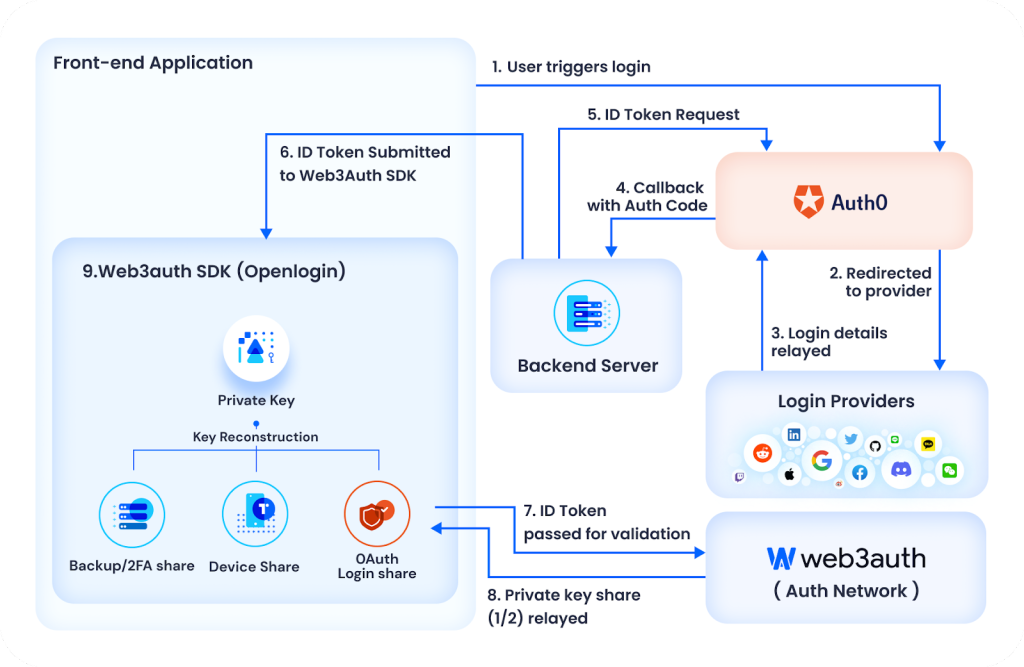
Embedded wallet onboarding architecture using social login and Web3Auth SDK for automatic wallet creation (Source: Web3Auth Documentation)
Research from a16z indicates that simplifying wallet creation can increase onboarding conversion by up to 3–4× compared with traditional wallet installation flows.
3. Gasless Transactions Reduce First-Time User Friction
Gas fees create another major usability barrier. New users often abandon onboarding when they discover they must purchase tokens before performing any action.
Gas abstraction models allow applications to sponsor transaction fees through mechanisms such as:
- Meta-transactions
- Relayer networks
- Paymaster systems
By removing the requirement to hold tokens upfront, users can interact with blockchain applications immediately. This dramatically improves early-stage Web3 user experience.
4. Hybrid Custodial Models Enable Gradual Web3 Adoption
The debate between custodial and non-custodial onboarding remains central to Web3 product design.
Each model offers distinct benefits:
Custodial onboarding
- Faster signup experience
- No seed phrase management
- Lower initial complexity
Non-custodial onboarding
- Full user asset ownership
- Stronger decentralization guarantees
- Reduced platform dependency
Many successful Web3 products now adopt hybrid onboarding strategies, allowing users to begin with simplified custody models and transition to self-custody over time.
Studies from Chainalysis suggest that gradual onboarding approaches significantly improve retention among new Web3 users.
Designing Web2 to Web3 Onboarding for Mass Adoption
Organizations building Web3 applications for global audiences must rethink product design from the perspective of user familiarity. Successful Web2 to Web3 onboarding experiences typically share several architectural principles:
Frictionless account creation
- Social login or passkey authentication
- Automatic wallet generation
- Seamless account recovery options
Abstracted blockchain complexity
- Gasless or sponsored transactions
- Smart contract wallet logic
- Automatic network management
Progressive decentralization
- Optional migration from custodial to self-custody
- User education built into product flows
- Gradual exposure to blockchain mechanics
This design philosophy mirrors how the early internet evolved. Email, cloud storage, and online banking all became mainstream only after their interfaces were simplified for non-technical users.
The same principle now applies to Web3 infrastructure. Applications that successfully implement these patterns will likely define the next phase of blockchain adoption.
Conclusion
The next wave of blockchain adoption will not be driven purely by technical innovation. It will be shaped by how effectively Web3 products remove usability friction for mainstream users.
Designing effective Web2 to Web3 onboarding requires rethinking how wallets, transactions, and authentication systems interact with the user interface.
Technologies such as account abstraction, embedded wallets, and gasless transactions are already demonstrating how decentralized systems can deliver experiences comparable to Web2 platforms.
As Web3 ecosystems mature, the projects that win will not simply be those with the most advanced blockchain infrastructure. They will be the ones that make decentralized technology feel effortless for ordinary users.
Organizations building Web3 products that target mass adoption increasingly require expertise in wallet-native UX design, scalable blockchain infrastructure, and seamless onboarding architecture. Twendee helps technology companies design Web3 platforms with frictionless onboarding flows, ensuring decentralized applications deliver a user experience that matches modern Web2 standards.
Reach out to Twendee: https://twendeesoft.com/
Read our latest article here: Do Web3 Developers Over-Optimize for Decentralization Too Early?