

AI organizational readiness has become a pressing concern for business leaders as artificial intelligence evolves at breakneck speed. The truth is, AI technology is advancing faster than most organizations can adapt. In 2024, 78% of organizations reported using AI, up from 55% just a year prior. Yet widespread usage doesn’t equal true integration or value. One study found that only 26% of companies have developed the capabilities to move AI from pilot projects to real business impact meaning a staggering 74% have yet to see tangible value from their AI efforts. This gap between AI’s rapid advancement and organizational readiness is becoming increasingly evident. People worldwide recognize AI’s transformative potential, but many struggle with AI adoption barriers that prevent them from keeping pace.
In this blog post, we’ll explore why AI is outpacing organizational change, what challenges (“AI adoption barriers”) are slowing companies down and how focusing on people, processes and AI governance, not just technology is key to catching up. We’ll also discuss how effective AI change management and bridging the internal capability gap can position your organization to thrive in the AI era.
The Rapid Pace of AI vs. Organizational Readiness
The past few years have seen an explosion of AI capabilities, from generative AI tools like ChatGPT to widespread automation in every industry. Businesses are “all in” on AI, fueling record investments and deployments. But while AI technology accelerates, many organizations remain stuck in earlier gear. This disconnect is summed up by a recent insight: “AI ambition is outpacing readiness, AI is moving faster than organizations can adapt.”.
To illustrate, McKinsey’s 2025 AI report found that nearly 92% of companies plan to increase AI investments, yet only 1% of business leaders feel their organization is truly “AI mature”, meaning AI is fully integrated into workflows and delivering substantial outcomes. In fact, McKinsey concludes that employees are largely ready for AI, but leadership and organizational structures are not. The biggest barriers to scaling AI are not technical hurdles or employee pushback; the obstacles are at the leadership and strategy level, with companies lacking the agility and vision to steer the organization toward AI-driven transformation.
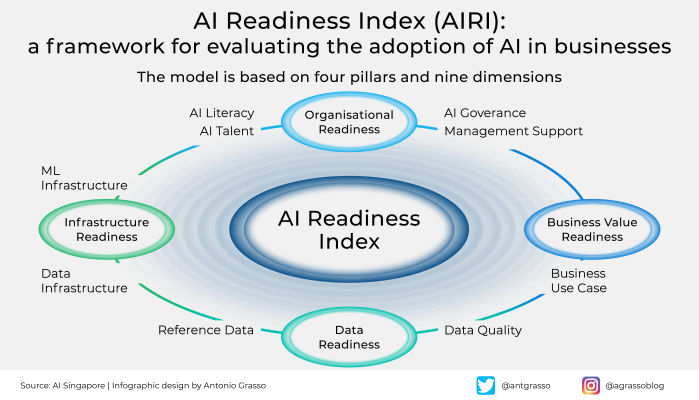
AI Readiness Index (AIRI) framework illustrating organizational, data, infrastructure and business readiness dimensions (Source: AI Singapore)
Multiple surveys reinforce how organizational readiness lags behind AI advancements:
- Fast-changing skills requirements: AI is entering workplaces faster than employees can be formally trained, raising expectations before teams have the skills or clarity to adjust. In one workforce trends report, 33% of employees doubted their skills would meet the demands of new AI-driven roles. Workers feel the pressure to keep up, even as hiring freezes mean leaner teams must do more with AI. This creates stress and internal capability gaps that technology alone can’t fix.
- Pilot projects vs. scaled impact: It’s easy to experiment with AI, but much harder to integrate it into core business processes. Industry data shows most AI pilots fail to scale into production deployments, reflecting a misalignment between experimentation and enterprise readiness. One global survey found that while many firms run AI pilots, only 54% of AI pilot projects actually reach production environments. Without a plan to get from proof-of-concept to enterprise-wide implementation, organizations stall out before realizing AI’s value.
- Lack of ROI despite adoption: As noted earlier, three out of four companies haven’t yet achieved real business value from AI. Even among companies actively pursuing AI, 76% of business leaders say implementing AI is challenging. They invest in AI tools but struggle with the operational changes needed to generate ROI. This can lead to frustration and “AI fatigue” if leadership expected quick wins.
Why is this happening? Let’s break down the common AI adoption barriers holding organizations back from full AI readiness.
Common AI Adoption Barriers (Beyond Just Technology)
Adopting AI at scale isn’t as simple as installing software or hiring a few data scientists. It requires holistic change. Here are some of the top barriers to AI adoption that CEOs, CTOs, and other leaders need to address:
- Unclear AI strategy and use cases: Many organizations jump into AI without a clear roadmap. Without a well-defined strategy tied to business goals, AI initiatives remain siloed experiments that don’t scale or deliver ROI. In a recent survey, more than half of business leaders admitted their AI efforts aren’t aligned with their overall corporate strategy, limiting impact to piecemeal efficiency gains. In short, if leadership hasn’t answered “AI for what?”, projects can drift without direction.
- Internal capability gap (skills shortage): A lack of skilled personnel is often cited as the #1 barrier to AI adoption. Companies simply don’t have enough AI and data talent, and existing staff may not have the training to work effectively with AI. For example, in the life sciences sector the share of organizations citing “lack of people” as a barrier to AI jumped from 23% to 34% in one year. This skills gap is not only in technical roles; it also includes managers who may not understand AI and thus hesitate to green-light or champion AI projects. Insufficient internal expertise forces reliance on vendors or causes AI projects to stall.
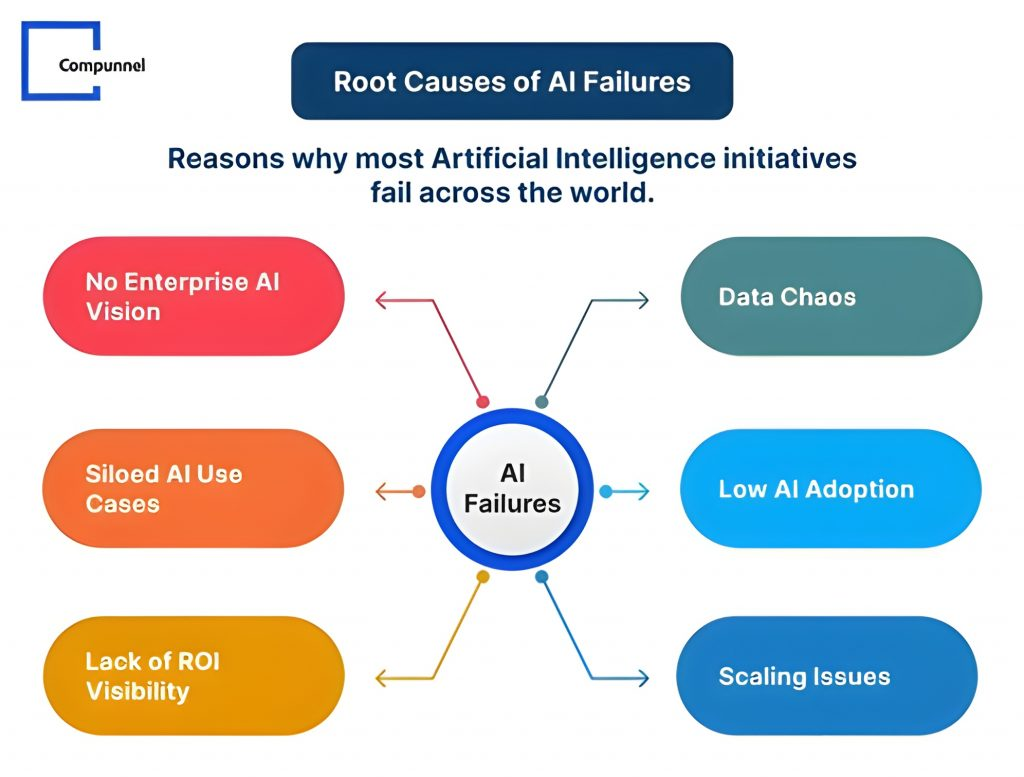
Root causes of AI failures highlighting organizational, data, adoption, and scaling gaps beyond technology (Source: Compunnel)
- Data quality and availability issues: AI is only as good as the data feeding it. Poor data quality and siloed, inaccessible data remain major challenges for 56% of companies. If your data is incomplete, inconsistent, or locked away in legacy systems, AI models will perform poorly or require extensive prep work. Integrating AI with legacy IT is another hurdle many enterprises struggle to plug advanced AI systems into their older, rigid infrastructures. These integration challenges can significantly slow down AI deployment.
- Employee adoption and cultural resistance: Introducing AI means changing how people work. Without proactive AI change management, employees may resist new AI-driven processes or fear that AI will replace their jobs. Insufficient employee buy-in was identified as a key barrier in many organizations. Even when workers are enthusiastic about AI, they need clarity on how it affects their roles. Miscommunication here can lead to confusion, anxiety, or misuse of AI tools. Change fatigue is real if AI adoption feels like yet another top-down initiative with no support, engagement will falter.
- Governance, risk, and compliance concerns: AI raises new questions about ethics, bias, security, and regulatory compliance. AI governance is about having the policies and oversight to use AI responsibly. Yet a surprising number of organizations lack such frameworks. Surveys show less than half of businesses have any formal AI governance policy in place. According to one report, only 10% of companies have a comprehensive AI policy, while more than 25% have no policy at all (and no plans to develop one). This governance gap makes executives and regulators nervous. Leaders worry (rightfully) about reputational and legal risks if AI systems behave unpredictably or unethically. In highly regulated industries, unclear guidelines can stall AI adoption altogether. Without trust and transparency, scaling AI is hard both employees and customers need to know there are “guardrails” ensuring AI is used correctly.
- High implementation costs and ROI uncertainty: Implementing AI at scale can require significant up-front investment – not just in software and infrastructure, but in training, process redesign, and maintenance. For some, the costs and unclear short-term ROI are a barrier. Organizations may pilot AI in one area, but hesitate to fund wider rollouts without a clear business case. This is often tied to the strategy issue: if you haven’t identified high-impact use cases and metrics, it’s difficult to justify the costs of broad AI deployment.
It’s important to note that these barriers are largely organizational and human in nature not the AI technology itself. In fact, industry research consistently finds that the companies successfully reaping AI’s benefits are those who excel at the non-technical work of change management, talent development, and process integration. Let’s explore this idea further.
People, Processes and AI Governance: The Real Keys to AI Readiness
If your organization is struggling to keep up with AI, focusing more on people and process (and governance) rather than just the technology can make all the difference. The experience of “AI leaders” organizations that are ahead of the curve underscores this point.
According to a Boston Consulting Group study, top AI-performing companies allocate 70% of their AI effort to people and processes, and only 30% to technology (20% data/tech + 10% algorithms). In other words, they succeed by investing in change management, training, organizational structure, and governance, not just fancy algorithms. Less successful firms often do the opposite over-focusing on tools while under-investing in workforce enablement and process change.
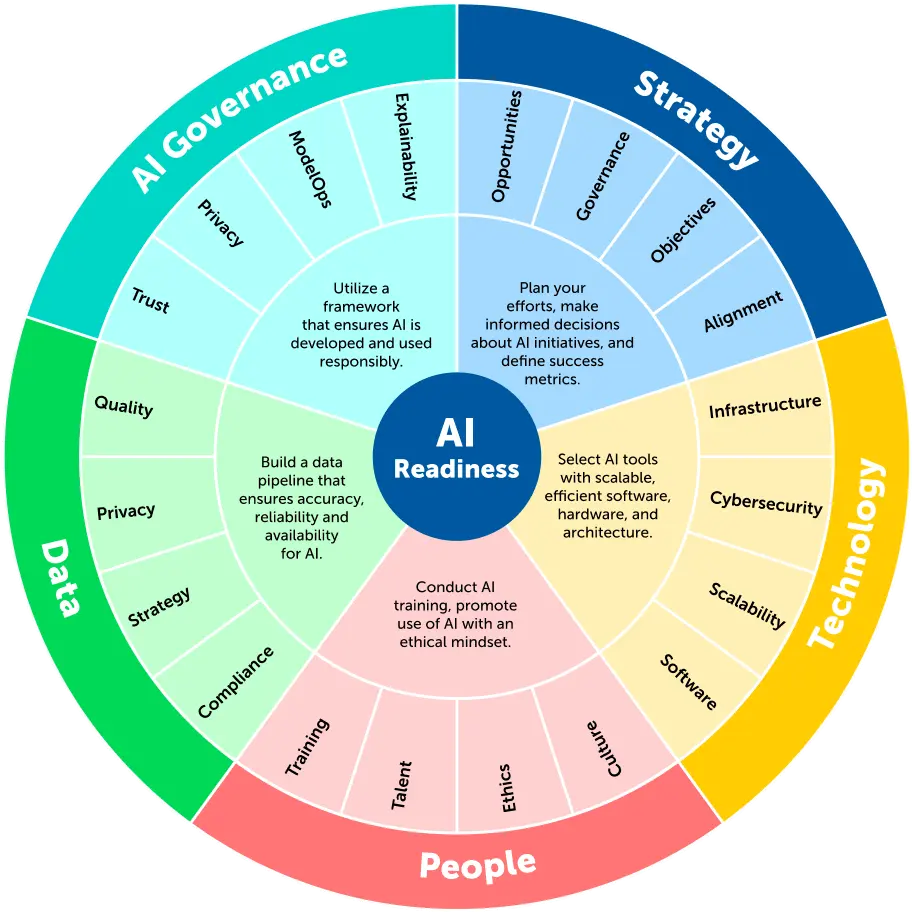
AI readiness framework highlighting the interplay between strategy, technology, data, people, and AI governance (Source: Microsoft)
Here are several human-centric factors critical to improving AI readiness in your organization:
- Leadership and vision: Strong executive leadership is needed to drive AI adoption at the right pace. McKinsey’s research concludes that the biggest barrier to AI success is a lack of bold leadership action, not employee resistance. Leaders must articulate a clear vision for AI, set ambitious yet realistic goals, and actively steer the organization through the transformation. This includes aligning AI initiatives with business strategy (so they get proper funding and attention) and role-modeling an adaptable mindset. Leadership also needs to address fears honestly for example, by emphasizing AI’s role in augmenting employees rather than replacing them, and by creating a culture of innovation and learning.
- Employee engagement and training are often underestimated barriers. In reality, employees are more ready for AI than many leaders assume. Surveys show most workers already see productivity gains from AI and expect it to improve their roles further. This optimism can accelerate adoption, but only if it is supported with clear guidance. Many employees want to build AI skills yet lack structured direction. Research indicates workers are far more likely than leaders expect to believe AI will significantly change their work, revealing a strong appetite for upskilling. Effective AI change management therefore hinges on communication and education: explaining why AI is being adopted, how roles will evolve and what training, mentorship and safe experimentation environments are available to help employees adapt with confidence.
- Change management and process integration: Implementing AI is a change project as much as a tech project. Without clear strategy, adequate training, and strong change management, AI initiatives will falter. As one report succinctly put it: “Without clear strategy, training, and strong change management, pressure mounts on remaining teams and gains fall short.”. Organizations need to redesign processes and workflows to integrate AI smoothly into day-to-day operations. This might mean rethinking team structures, redefining job roles (so AI handles certain tasks while humans focus on others), and establishing new cross-functional collaboration between IT, data teams, and business units. It also means setting realistic timelines AI adoption is a transformation, not a quick fix. Managing this change requires dedicated effort: frequent communication, change champions in each department, feedback loops to address issues, and patience as people climb the learning curve. When done right, the payoff is huge: employees empowered by AI can be more productive and innovative, rather than stressed by it.
- Robust AI governance and ethics: In the rush to deploy AI, governance is often overlooked. Yet AI governance is essential to ensure responsible, ethical, and compliant use, covering data privacy, bias control, security, and accountability. Most organizations still lack clear AI guardrails, making this a critical gap to close. Establishing cross-functional governance involving IT, legal, compliance and HR helps manage vendor risk, monitor AI outcomes and respond to failures before they escalate. This is not bureaucracy but risk management and trust-building. As AI regulations accelerate globally, companies with proactive governance are better positioned to comply and scale confidently. Strong governance also addresses employee and customer concerns around opaque “black box” systems, especially in sensitive areas like HR, where unchecked AI can reinforce bias. Responsible AI is therefore not only an ethical obligation but a practical foundation for sustainable adoption.
- Iterative approach and learning culture: Given how fast AI technology changes, organizations must embrace continuous learning and iteration. Rigid five-year plans won’t work when new AI models emerge every few months. Instead, cultivate a culture where teams pilot new AI solutions on a small scale, learn from failures, and quickly refine their approach. Encourage cross-pollination of ideas – for example, if one department finds a successful way to use AI for forecasting or customer service, share that knowledge across the company. Celebrate quick wins to build momentum, but also acknowledge and analyze setbacks without blame. The goal is to make your organization more adaptable. Businesses that treat AI adoption as a one-and-done deployment often fall behind. Those that treat it as an ongoing journey continually updating skills, processes, and controls are the ones that will thrive as AI evolves.
In summary, achieving AI organizational readiness is as much about mindset and management as it is about technology. When you address the human side of AI adoption through vision, training, change management, and governance – you create an environment where AI can deliver its promised value. As one set of researchers concluded, the challenge for business leaders isn’t convincing people of AI’s value; it’s building the structures that balance automation with accountability, data with human judgment, and efficiency with trust. In other words, success comes from an organizational framework that empowers people to harness AI effectively, rather than being overwhelmed by it.
Conclusion
AI is moving fast, but it is not a magic bullet. Organizations that succeed will be those that evolve their structure, culture, and governance as quickly as they adopt new tools. The real risk lies in the growing gap between rapid AI innovation and slower organizational change. When left unaddressed, this gap leads to stalled initiatives, wasted investment, and employee frustration.
The path forward is clear. Focusing on people, process, and governance accelerates AI maturity and turns experimentation into real performance gains. Companies that invest in skills, change management, and clear guardrails are already seeing higher productivity, stronger innovation, and durable competitive advantage.
AI adoption is not a one-time rollout but a continuous journey. By closing internal capability gaps, aligning AI with business strategy, and building trust through responsible governance, organizations can turn AI’s pace from a source of pressure into a lasting advantage.
If your organization could use expert guidance on this journey, Twendee’s IT services are here to help. We have the experience and holistic approach to guide you in building AI readiness from the ground up – technically, operationally, and culturally. Don’t wait until you’re left behind. The companies that act now to adapt their people and processes to AI will lead their industries tomorrow.
Ready to close the gap between AI ambition and organizational readiness? Contact Twendee today to discover how we can help you develop a winning AI strategy, build internal capabilities, and implement AI solutions that deliver real value. AI is moving fast – but with the right partner and plan, your organization can move faster.
Contact us: Twitter & LinkedIn Page
Read latest blog: Why Most Web3 Products Struggle to Reach Real Users