

Enterprise AI is moving beyond a simple question of which model performs best on public benchmarks. As AI becomes part of customer support, finance, operations, internal knowledge, document processing and software development, enterprises need to ask a more practical question: which model strategy fits each workload?
For many teams, proprietary AI APIs remain the fastest path to deployment. They offer strong model quality, managed infrastructure and mature tooling. But stronger open weight AI models are changing the range of options. Enterprises can now consider whether some workloads should run through a closed API, some should use open-weight models in a controlled environment, and some should combine both.
The value of open-weight AI is not that it replaces closed models. Its value is that it gives enterprises more control over cost, data, customization and deployment location when those factors matter.
Open-Weight AI Changes the Enterprise Model Choice
The term open weight AI models usually refers to models whose trained weights are available for others to download, deploy, evaluate or fine-tune, depending on the license. This is different from a closed model, where enterprises usually access the model through an API or a managed platform without seeing or controlling the underlying weights.
It is also different from the broader phrase open source AI models. In software, open source usually means the source code is available under a license that allows use, modification and redistribution. In AI, “open” can mean different things: open weights, open model architecture, open training code, open datasets or open usage rights. Many models described as open do not make every part of the training process public.
For enterprise leaders, the distinction matters because model openness affects what the company can control.
A closed model may be better when the business needs fast deployment, strong general performance and less infrastructure responsibility. An open-weight model may be better when the business needs more control over where the model runs, how it is tuned, how data is handled and how cost behaves at scale.
The market is moving in that direction. Stanford’s 2025 AI Index reports that 149 foundation models were released in 2023, more than double the number released in 2022. Of those newly released models, 65.7% were open-source, compared with 44.4% in 2022 and 33.3% in 2021.
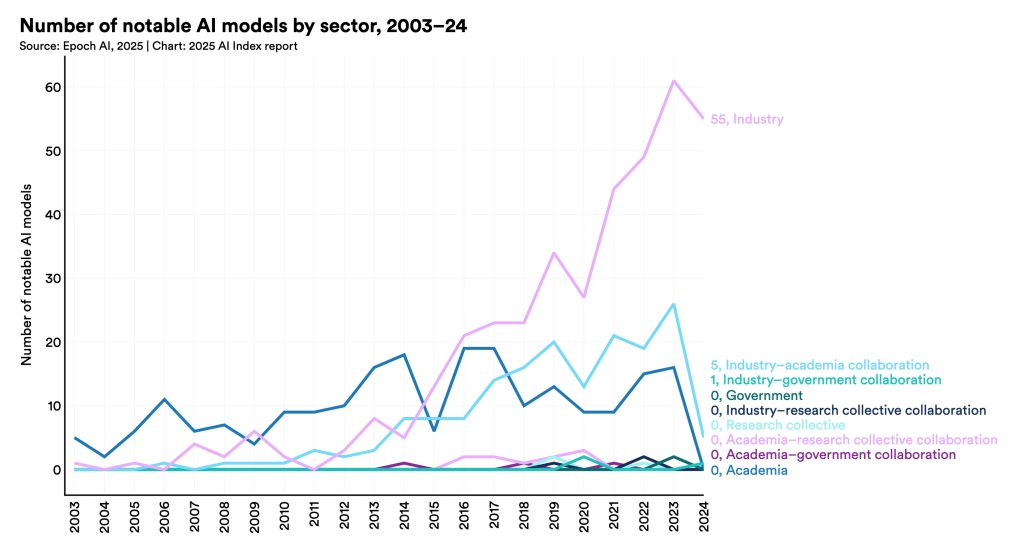
Gartner also predicts that by 2027, organizations will use small, task-specific AI models at least three times more than general-purpose large language models. Gartner notes that the accuracy of general-purpose models declines when tasks require specific business domain context.
Together, these signals point to a broader shift. Enterprises are moving away from the idea that one large model should handle every task. The better approach is often to match the model to the workload.
Cost Control Becomes More Important When AI Usage Scales
In early AI experiments, cost is usually manageable. A team tests a chatbot, summarizes documents, builds a support assistant or creates an internal search tool. The usage is limited, and API cost may feel acceptable.
The economics change when AI becomes part of daily operations.
A support assistant may answer thousands of customer questions. A finance workflow may check invoices, contracts and payment records every day. A sales tool may summarize account activity for every opportunity. A document workflow may process large volumes of files. As usage grows, cost depends on model size, token volume, latency needs, caching, infrastructure, monitoring and the number of steps involved in each workflow.
Stanford’s 2025 AI Index shows how quickly AI costs can shift. The cost of querying an AI model with GPT-3.5-level performance dropped from $20.00 per million tokens in November 2022 to $0.07 per million tokens by October 2024, a reduction of more than 280x in about 18 months.
That drop is good news, but it also shows why enterprises need flexible model architecture. AI economics change quickly. A workload that is expensive today may become cheaper later. A model that is efficient for one task may be wasteful for another. A vendor that looks cost-effective during testing may become expensive when usage grows across thousands of daily interactions.
Open-weight models are not automatically cheaper. If an enterprise self-hosts AI, it may need GPU infrastructure, model serving, optimization, security, monitoring and engineering support. Poorly managed self-hosting can become expensive very quickly.
But open-weight models give enterprises more cost levers. A company can choose smaller models for repeated tasks, optimize inference for predictable workloads, cache common responses, fine-tune models for narrow use cases, or run workloads in an environment where infrastructure cost is easier to control.
This matters because many enterprise AI workloads do not need the largest available model. A customer classification task, invoice extraction workflow, internal policy search or routing assistant may perform well with a smaller, task-specific model if the data and workflow are designed properly.
Cost control therefore becomes less about choosing the cheapest model and more about choosing the right model for each job.
Data Control Is Becoming a Stronger Reason to Consider Open-Weight Models
For many enterprises, the most important question is not only how well the model answers. It is also where the data goes.
AI workflows may involve customer records, employee information, contracts, invoices, legal documents, operational data, product details or internal policies. Some of this data may be sensitive. Some may be regulated. Some may need to remain in a specific country, cloud region or internal environment.
When using a closed model API, enterprises need to understand what data is sent to the provider, how prompts and outputs are handled, whether data is retained, what security controls apply and how the provider’s terms affect enterprise use. For many workloads, this can be acceptable. For others, the risk profile may be too high.
Open-weight and self-hosted AI can give enterprises more control in these situations. The model can run closer to internal systems. Sensitive data can remain inside a private cloud, on-premise environment or controlled infrastructure. Access rules, logging and monitoring can be designed around the company’s own governance requirements.
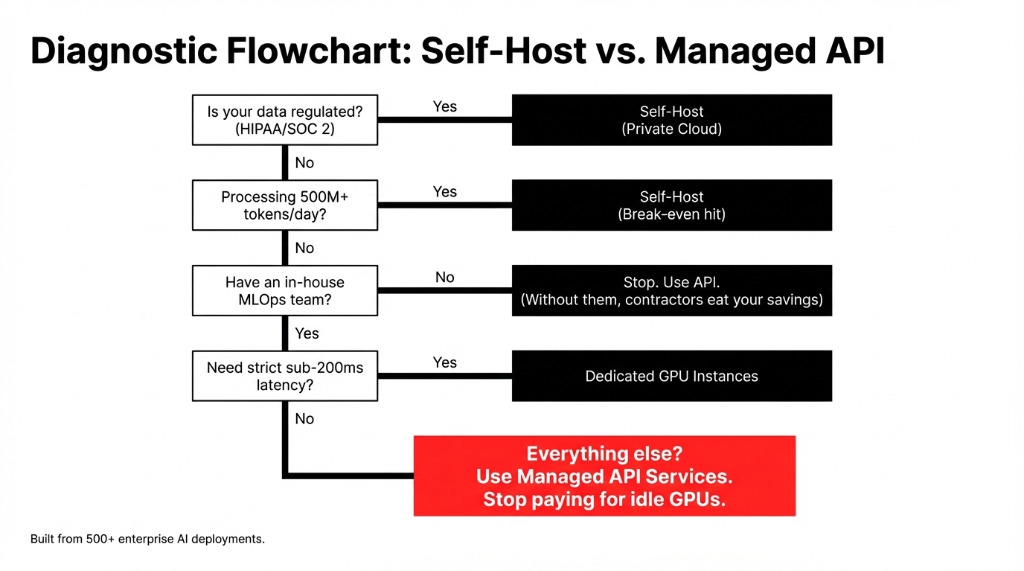
Reuters described open-weight AI as an imperfect but important hedge for organizations concerned about where sensitive data is stored, who can inspect models and whether access can be cut off by a third party. Gartner has also noted that open-source LLMs can increase innovation potential through customization, better control over privacy and security, model transparency, collaborative development and reduced vendor lock-in.
The point is not that every sensitive workflow must use open-weight AI. The point is that enterprises now have more architecture choices. For a low-risk marketing draft, a closed API may be enough. For finance, legal, healthcare, manufacturing, supply chain or internal operations, data control may become a stronger reason to evaluate open-weight deployment.
Deployment Location Becomes Part of AI Strategy
AI strategy is no longer only about choosing a model. It is also about deciding where that model should run.
Some workloads may run well through public cloud APIs. Others may need private cloud infrastructure. Some may need to run on-premise because of data sensitivity, latency, regulatory requirements or integration with legacy systems. In industrial, retail, logistics or edge environments, certain AI workloads may need to run close to where data is produced.
This is where self-hosted AI becomes relevant. Open-weight models can be deployed in environments that match business requirements more closely. A company may run a smaller model near operational data, use a proprietary model for general reasoning and rely on another provider for specialized tasks.
This flexibility is useful, but it also adds responsibility. Enterprises need model serving, monitoring, version control, security, access management, evaluation, incident response and cost governance. A model that runs in a private environment still needs to be operated like production software.
That is the real lesson for enterprise teams. Open-weight AI creates more deployment freedom, but freedom needs architecture. Without governance, observability and operational discipline, enterprises may simply move complexity from the API provider into their own infrastructure.
This is where Twendee’s role becomes practical. Twendee helps enterprises evaluate where AI workloads should run, which model approach makes sense and how the model should connect with ERP, CRM, finance, support or internal systems without disrupting existing operations.
Open-Weight vs Closed Models Should Be Decided by Workload
The wrong question is: should the enterprise choose open-weight or closed models?
The better question is: which workload needs which model strategy?
Closed models often make sense when the enterprise needs:
- Fast deployment.
- Strong general reasoning or language capability.
- Managed infrastructure.
- Mature tooling and support.
- Lower operational burden.
- A workload that is not highly sensitive or highly repetitive at scale.
Open-weight models often make sense when the enterprise needs:
- More control over data location.
- Deeper customization for a specific task.
- Lower dependency on one provider.
- Deployment inside a private or on-premise environment.
- Cost optimization for high-volume repeated workloads.
- More visibility into model behavior and operations.
In practice, many enterprises will use a hybrid approach. A closed model may support general-purpose reasoning, prototyping or low-risk tasks. An open-weight model may support sensitive internal workflows, domain-specific tasks or high-volume processes where cost and control matter more.
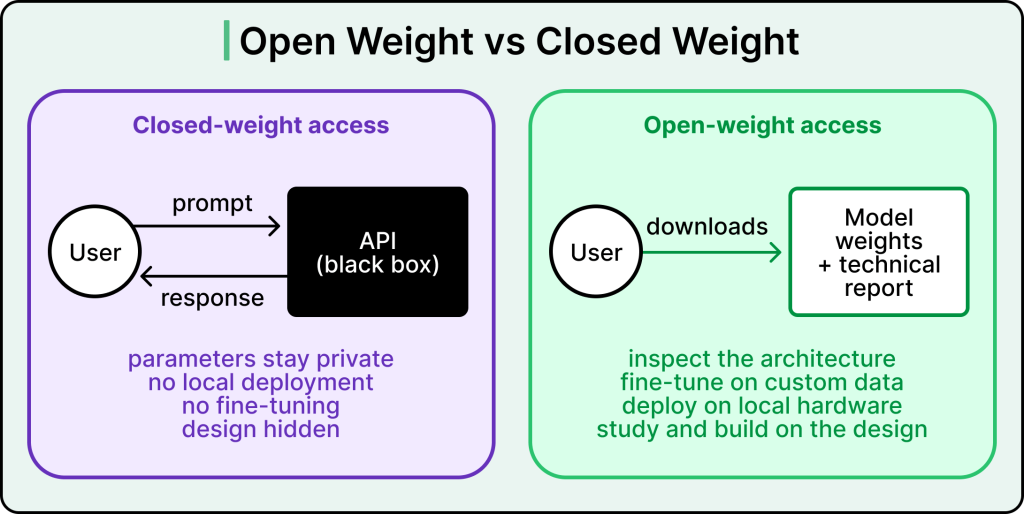
This is also where the comparison between open weight vs closed models becomes more useful. The decision should not be based on ideology or hype. It should be based on workload requirements: data sensitivity, performance needs, latency, cost profile, customization depth, governance requirements and available engineering capacity.
What Enterprises Should Evaluate Before Choosing a Model Strategy
Before choosing a model strategy, enterprises should define the workload clearly. A model decision made without workload context can easily become expensive or difficult to maintain.
A practical evaluation should answer these questions:
- What business process will the model support?
- What data will the model need to access?
- Is the data sensitive, regulated or location-specific?
- How often will the workload run?
- Does the model need customization or fine-tuning?
- What accuracy level is acceptable?
- What latency and uptime does the business need?
- Who will monitor model performance and cost?
- What needs to be logged for audit and compliance?
- How will the model connect with existing systems?
These questions help enterprises avoid two common mistakes.
The first mistake is using a closed model for every workload because it is easier at the start. That may create long-term cost, data and dependency issues.
The second mistake is self-hosting open-weight models without the right operational foundation. That may give the company more control in theory, but more engineering burden in practice.
Twendee evaluates open-weight, proprietary and hybrid AI architectures based on security, cost, performance, data control and deployment requirements. From there, Twendee helps deploy models inside existing enterprise environments, so AI can work with real systems instead of sitting as a separate experiment.
Conclusion
Open weight AI models do not replace proprietary models for every enterprise use case. But they give companies more control over some of the decisions that matter most as AI moves into production: cost, data, customization and deployment location.
As AI usage scales, enterprises need to stop choosing models only by brand name or benchmark scores. The better approach is to evaluate each workload: what data it uses, where it should run, how much control it needs, how often it runs and what operational risk it creates.
For many businesses, the future will be hybrid. Proprietary models will remain useful for fast deployment and strong general capability. Open-weight and self-hosted models will become more important for sensitive data, high-volume workloads, specialized tasks and controlled enterprise environments.
The enterprise AI question is no longer simply which model is best. It is which model strategy gives the business the right balance of performance, control and scalability.
Book a call: Calendly
Read latest blog: Why Enterprise AI Projects Stall After the First Success