

A strong pilot proves that AI works in one workflow. The harder question is whether the organization can deploy it repeatedly. That gap explains why many enterprise AI implementation programs lose momentum after an impressive first result. The next stage requires an AI deployment strategy, a reusable foundation for scaling AI, and an enterprise AI roadmap connecting technology with ownership, governance, and operational change.
A Successful AI Pilot Can Hide an Organization’s Readiness Gap
The first AI project often receives conditions that later projects will never enjoy. The scope is narrow, the data is prepared carefully, senior leaders pay close attention, and a small technical team stays close to the workflow. Exceptions can be handled manually, integrations can be simplified, and success can be measured through a limited set of indicators such as accuracy, time saved, or user feedback.
These conditions are useful for proving feasibility. They also make the pilot a poor test of enterprise readiness.
The difference becomes visible when the organization moves from one workflow to several. A customer-service assistant may need access to CRM, order management, payment, and logistics data. A finance use case may require different permissions, approval thresholds, audit requirements, and business owners. Another project may be led by a separate department using another platform. Each initiative appears to progress, yet the company keeps rebuilding the same underlying work.
McKinsey’s 2025 State of AI survey found that 71% of respondents said their organizations regularly used generative AI in at least one business function. At the same time, more than 80% reported no tangible enterprise-level EBIT impact, and only 1% of executives described their generative AI rollouts as mature.
After the first success, the executive question should change. Leaders need to know whether the assets, controls, and operating knowledge created by that project will make the next deployment faster and safer.
Enterprise AI Stalls in the System Around the Model
When AI performance disappoints, attention usually moves toward model selection, prompt quality, retrieval accuracy, or fine-tuning. Those decisions matter, particularly when a use case depends on specialist knowledge or low tolerance for error. Across an enterprise portfolio, model quality is only one part of delivery.
Every production AI workflow needs a way to access trusted data, respect user permissions, connect with enterprise software, escalate exceptions, record actions, and measure results. When these elements are designed separately for every project, implementation costs rise with each new use case. The organization gains more pilots, while its ability to deploy them remains almost unchanged.
Governance creates a similar pattern. Security, legal, compliance, and data teams may review the first pilot as a special initiative. As demand grows, those teams face projects with different risk definitions, documentation, evaluation methods, and approval processes. Review becomes slower because the company has no repeatable path into production.
Ownership is equally important. A pilot usually has a sponsor. A scaled workflow needs durable accountability for data quality, model and prompt changes, business rules, adoption, maintenance, and KPIs. Without that ownership, the solution can remain technically available while operational use declines.
BCG’s AI adoption study found that 74% of companies struggled to achieve and scale value from AI. The firms identified as AI leaders pursued roughly half as many opportunities as less advanced peers, yet scaled more than twice as many AI products and services. Their advantage came from concentration and execution discipline.
A model determines whether a use case is technically possible. The surrounding architecture and organization determine whether it can become part of normal business operations.
Scaling AI Requires a Shared Operating Model
Sustainable scale begins when AI is managed as a shared operational capability. Business units can continue to identify problems and shape workflows, while the enterprise establishes common infrastructure, governance, ownership, and implementation standards.
Reusable architecture is the technical expression of this operating model. Data connectors, identity controls, retrieval services, model access, evaluation tools, approval flows, observability, and integrations should become shared assets where the business context allows it. A new agent may require different instructions and process logic, but it should not require a completely new permission model or monitoring approach.
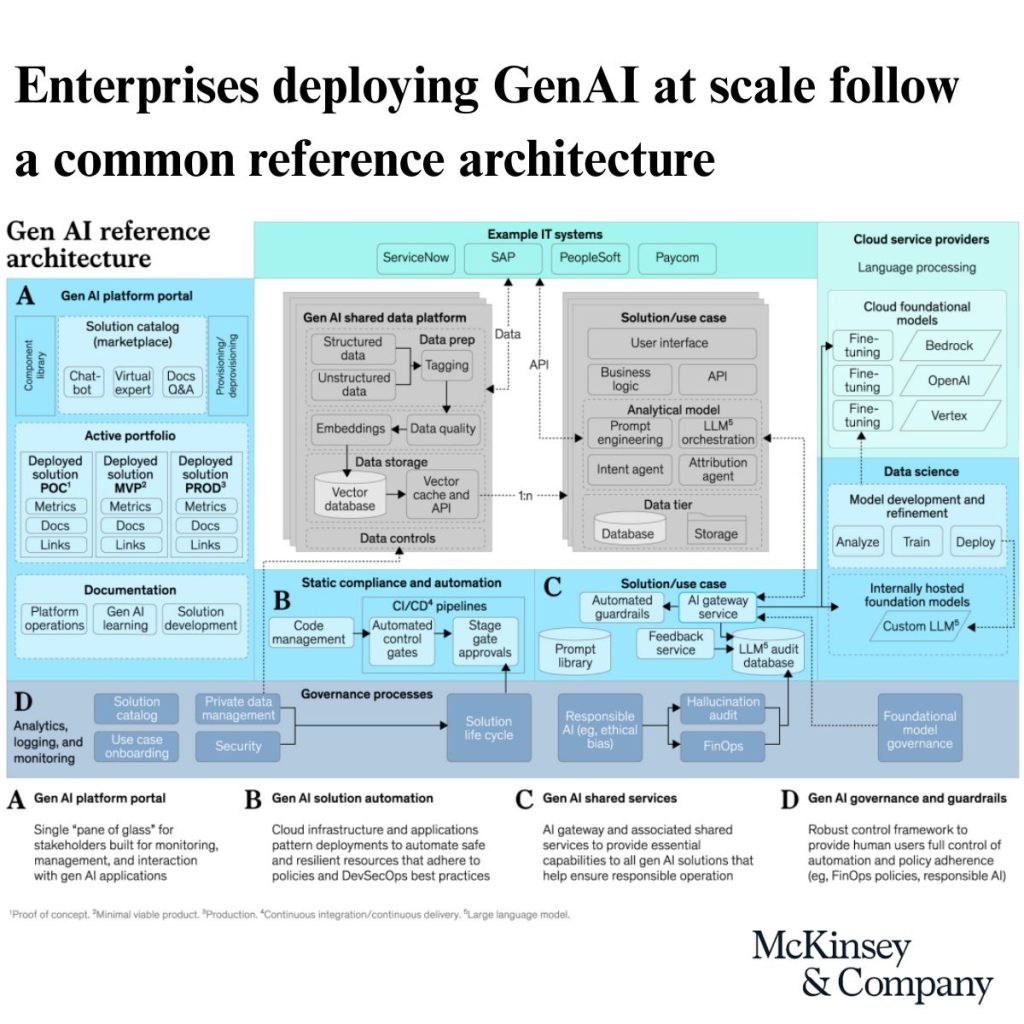
This changes the economics of deployment. The first project may carry the cost of building a connector or approval service. Later projects can reuse that work. Implementation time begins to fall, security reviews become more predictable, and technical teams spend more effort on workflow value.
Governance also needs to move into system design. Before production, each workflow should have clear answers to four questions:
- Which data and actions can the AI access?
- Where is human approval required?
- How are outputs, actions, and changes recorded?
- Who responds when quality or risk moves outside the accepted range?
BNY’s enterprise AI case shows how standardization can support speed. The bank embedded prompting, model selection, agent development, permissions, security, and oversight inside its governed AI environment, Eliza. Cross-disciplinary review boards and an enterprise AI council support the process, while 99% of the workforce has completed generative AI training. Teams work inside an approved path rather than negotiating a new path for every idea.
Ownership completes the model. Business leaders should own workflow outcomes and adoption. Technology teams should own reliability, integration, and platform evolution. Data owners should define access and quality expectations. Risk and governance leaders should set deployment boundaries. These responsibilities must continue after launch because production AI changes as data, models, regulations, and business processes evolve.
Shared implementation standards bring these elements together. Teams need a common way to evaluate use cases, test outputs and actions, document risk, release changes, and measure operational impact. McKinsey found that only 21% of respondents using generative AI had fundamentally redesigned at least some workflows, while fewer than one in five were tracking well-defined KPIs for their AI solutions. Both practices were associated with stronger bottom-line impact.
The practical sign of scale is simple: every completed deployment should leave behind components, standards, and knowledge that reduce the work required for the next one.
Enterprise AI Roadmaps Turn Projects into Compounding Capability
A useful enterprise AI roadmap shows how a sequence of projects will build reusable capability across the organization.
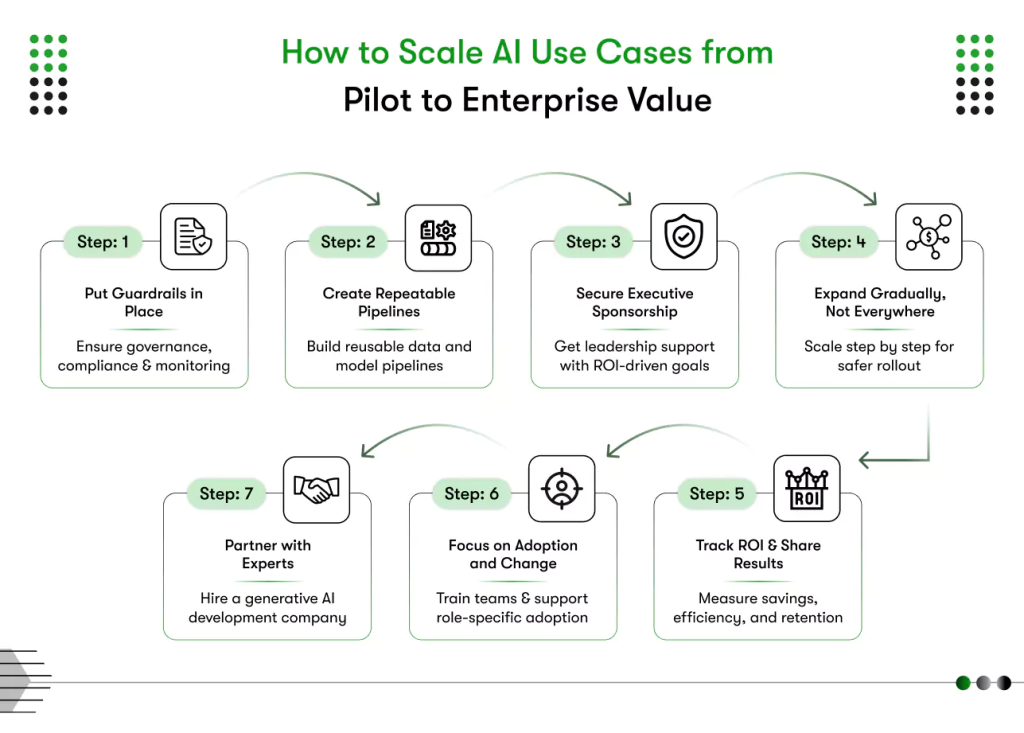
Each initiative should be evaluated on two levels. The first is direct workflow value: lower processing time, fewer errors, higher conversion, stronger service quality, or reduced revenue leakage. The second is the strategic value created for later deployments. A moderately valuable use case may deserve priority when it establishes access to a core system, creates an approval pattern, or builds a trusted data layer that several departments can reuse.
The roadmap should also connect implementation phases with organizational readiness. Early projects may focus on assisted decision-making with human review. Later stages can support more complex actions after the organization has strengthened evaluation, access controls, monitoring, and exception management. Governance should evolve with the level of autonomy.
Moderna’s enterprise AI rollout illustrates how a shared direction can create momentum across functions. The company combined leadership involvement, dedicated transformation support, training, internal champions, and a common enterprise platform. Within two months of adopting ChatGPT Enterprise, employees had created 750 GPTs, and 40% of weekly active users had built one themselves. These figures describe adoption rather than proven enterprise ROI, yet they show the reach possible when deployment is supported by common infrastructure and organization-wide enablement.
Twendee helps organizations translate business priorities into an enterprise AI roadmap, then design reusable foundations around real systems and workflows. This includes shared integration layers, controlled access, human approval, monitoring, and clear operational ownership. Each implementation can contribute to a broader capability instead of remaining an isolated solution.
Conclusion
The first AI success proves that a workflow can improve. Enterprise scale depends on whether the organization can repeat that success across different data, systems, risks, and teams.
Companies that build reusable architecture, embedded governance, clear ownership, and disciplined implementation create an advantage that compounds over time. Their next project begins with a stronger foundation.
Twendee helps businesses assess AI readiness, design practical enterprise AI roadmaps, and build reusable AI foundations connected to day-to-day operations. Visit the Twendee website, follow Twendee on LinkedIn, or book a conversation through Twendee’s Calendly.