

AI agents are becoming better at reasoning, planning and deciding what to do next. Yet better intelligence does not automatically translate into more work completed inside an enterprise. The harder constraint increasingly sits between the model and the systems where work actually happens.
Many business applications still expose incomplete APIs, limited integrations or no machine-accessible interface at all. This is why the browser for AI agents matters. The deeper shift, however, is not about giving agents another tool. It is about building execution infrastructure that allows machine intelligence to become reliable, controlled business action.
AI Agents Need More Than API Access
Enterprise AI has spent much of the past few years improving what models can understand. As agents move into operational workflows, attention is shifting toward what those models can actually reach and execute.
APIs remain the most reliable path for software-to-software interaction. They offer structured data, predictable operations and clearer access boundaries. But enterprise workflows rarely sit entirely inside systems with mature APIs.
According to MuleSoft’s 2026 Connectivity Benchmark Report, the average organization manages 957 applications, while only 27% are connected. The report also found that 82% of IT leaders identify data integration as a major challenge for AI initiatives. The implication is important: the intelligence layer may be advancing much faster than the infrastructure connecting that intelligence to business systems.
Consider an agent responsible for resolving an overdue invoice. Customer records may be available through CRM APIs and invoice data through an ERP integration. Yet proof of delivery could sit in a logistics portal, dispute history in an internal web tool and supporting documents behind a supplier website.
The agent may know exactly what information it needs and what action should follow. It still cannot complete the workflow if part of that process remains unreachable.
This reframes a common assumption about agent autonomy. Autonomy is not determined only by how well a model reasons. It is bounded by the execution infrastructure available around that model.
The practical architecture is therefore unlikely to be API-only. APIs will remain preferable wherever reliable machine interfaces exist, while agents will need another controlled execution path for the parts of enterprise work that still live behind interfaces.
Enterprise Software Was Built for Human Interaction
The challenge becomes clearer when looking at how most business software was designed.
Enterprise applications generally assume that a human sits between the interface and the action. That human implicitly handles ambiguity: recognizing an expired session, noticing that a page layout changed, checking whether the correct account is open or deciding whether a warning should stop a transaction.
Those behaviors are easy to overlook because people perform them almost automatically.
An agent has to make each of them explicit.
A seemingly straightforward workflow across an ERP, supplier portal and internal approval system can require the agent to preserve authentication, maintain task context, interpret changing UI states and recover from unexpected responses. The difficulty therefore does not always come from the underlying business logic. It often comes from translating that logic into reliable interaction with software built for people.
Recent improvements in computer-use models show how quickly this capability is progressing. OpenAI reported for GPT-5.4 strong gains on benchmarks such as WebArena-Verified and OSWorld-Verified, which evaluate browser and desktop interaction.
Those results matter, but the larger enterprise lesson lies elsewhere.
Better models do not automatically create reliable enterprise execution.
A benchmark can measure whether an agent successfully completes a task. A production system must answer additional questions: Was the correct identity used? Did the agent access only permitted information? Was the action appropriate for that customer or transaction? Could the organization stop or review the process before an irreversible action occurred?
Once agents begin operating business systems rather than simply reading from them, reliability depends on the environment around the model as much as the model itself.
The Browser Is Becoming an Execution Layer for Agentic Systems
This is where the browser begins to take on a different role.
For decades, browsers have served primarily as presentation layers: applications expose interfaces, and humans interpret those interfaces and decide what to do.
For an agentic system, the browser can become an execution layer between machine reasoning and applications that do not expose sufficient machine access.
Imagine a procurement workflow where an agent retrieves a purchase order through an ERP API, checks shipment status on a supplier portal, confirms a delivery slot through a logistics website and records the result back into the ERP.
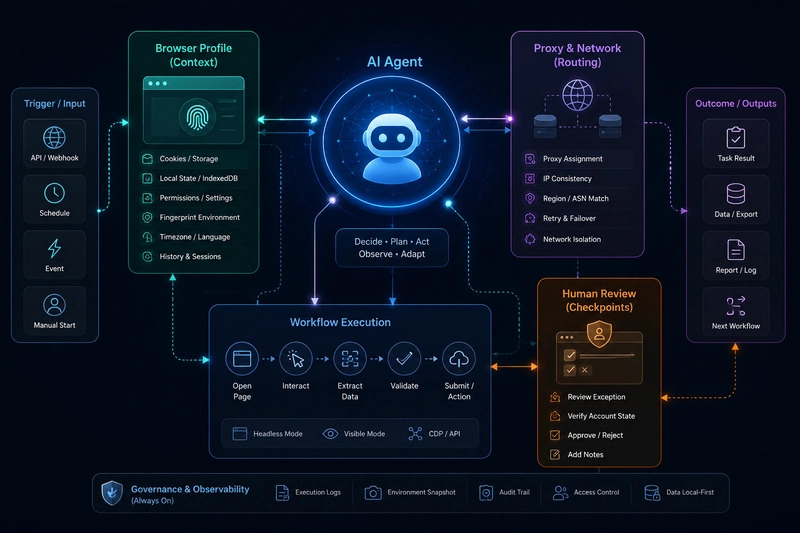
That workflow does not require choosing between APIs and browser automation. It requires both.
The agent can use structured integrations where they exist and browser execution where the interface remains the only practical access point.
This pattern is already appearing in enterprise agent platforms. Microsoft’s computer-use capabilities for Copilot Studio are designed to let agents interact with websites and desktop applications when direct APIs are unavailable, while combining those interactions with API actions, approvals and business logic.
The architectural implication is more important than any individual product capability.
A browser gives agents another path into existing enterprise infrastructure without requiring every application to be rebuilt around new APIs first. That can extend automation into legacy portals, partner platforms, internal tools and third-party applications that traditional integrations leave untouched.
But the moment a browser becomes part of execution, it also becomes part of the enterprise control surface.
That distinction is what separates simple AI browser automation from infrastructure suitable for production agent systems.
A Machine-Work Browser Needs More Than AI-Powered Navigation
A machine-work browser is not simply a traditional browser with an AI model controlling the mouse.
Human browsers are designed around continuous human supervision. The user owns the session, observes each state change and can intervene before taking a consequential action.
Autonomous execution removes that assumption.
A browser designed for machine work therefore needs an architecture that can manage six things together: identity, session and context, permissions, validation, recovery and monitoring.
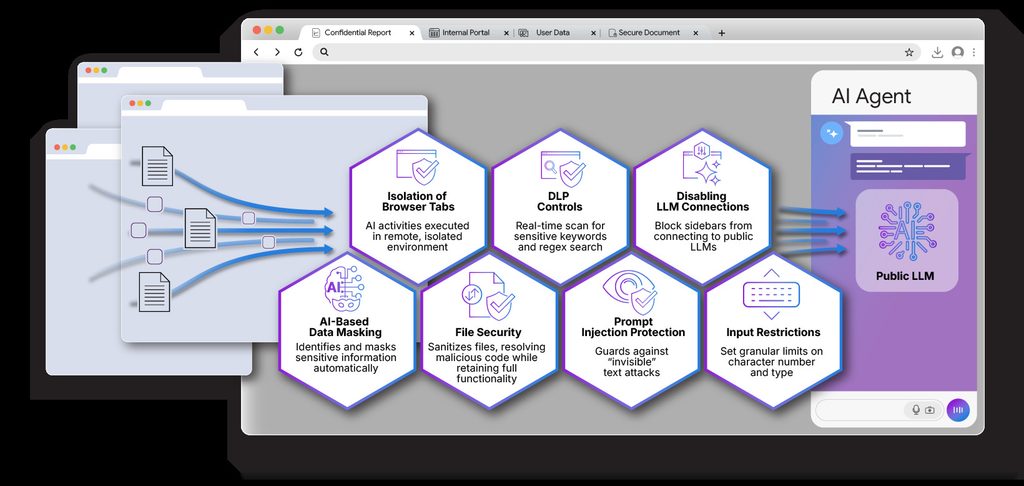
Identity establishes who or what the agent is acting as. A production agent cannot simply inherit unrestricted employee credentials. Its access needs to reflect the task, application and business role being performed.
Session and context management then ensure that the agent remains inside the correct account, customer, tenant or transaction while moving between applications. Losing context during a multi-step workflow is not merely a navigation error; in finance, procurement or customer operations, it can create a business error.
Permissions must also extend beyond application-level access. Reading an invoice, editing bank details and approving a payment may all occur inside the same system, but they carry radically different risk. The execution layer needs to distinguish between them.
Validation provides another boundary. Before an agent submits a form, sends an external message or changes an operational record, the environment should be able to check whether required conditions have been satisfied and route high-impact actions for approval.
Recovery matters because web interfaces are inherently variable. Pages change, elements fail to load and unexpected states appear. A machine-work browser needs the ability to retry safely, change approach, stop execution or escalate the task instead of blindly continuing.
Finally, monitoring creates an accountable execution trail: which system was accessed, what information was used, which action was proposed, whether approval was obtained and what ultimately happened.
Security research illustrates why this control layer matters. In browser-agent testing, Anthropic reported that additional safeguards significantly reduced successful prompt-injection attacks, while also emphasizing that browser interaction continues to require careful safety testing.
The broader point is straightforward.
For a human user, authentication may be enough to begin a trusted session. For an autonomous agent, trust must continue through every action performed after authentication.
The Next Layer of Enterprise Automation Will Combine Access With Control
This changes how businesses should think about agent deployment.
The objective should not be to give an agent maximum browser autonomy. It should be to give the agent enough execution capability to complete useful work while keeping that execution governed.
A mature enterprise architecture is therefore likely to combine three elements:
APIs where structured machine access already exists, browser execution where interfaces remain necessary, and a common governance layer across both.
That governance layer becomes the bridge between agent capability and operational trust. It determines which applications an agent can access, which actions can run automatically, where validation is required and when a human decision should remain inside the workflow.
This is also where Twendee approaches agent deployment. Rather than treating browser control as an isolated automation feature, Twendee can build agents that work across APIs, internal tools and web applications while surrounding execution with permissions, validation, approval checkpoints and monitoring.
The business value comes from extending automation without pretending the existing enterprise stack is cleaner than it really is.
Companies do not need to wait until every legacy portal has been replaced or every application exposes a perfect API. Agents can work across the environment businesses already have, provided that browser execution is designed as controlled infrastructure rather than unrestricted machine access.
The next frontier of agentic automation is therefore not simply more intelligent agents. It is an execution environment capable of turning that intelligence into action without giving up enterprise control.
Conclusion
As agents move from generating answers to completing operational work, model intelligence becomes only one part of the equation. Their practical autonomy will increasingly depend on whether enterprise infrastructure can give them reliable, permissioned and observable ways to act.
A purpose-built browser for machine work can extend agent execution beyond the limits of APIs, but its real value comes from the control architecture surrounding that access.
If your organization is exploring how AI agents can operate across APIs, internal systems and web applications, visit the Twendee website, follow Twendee on LinkedIn, or book a conversation through Twendee’s Calendly to design an execution architecture that turns AI capability into governed enterprise action.