
AI agents are moving from assistance into execution. They can call enterprise systems, trigger workflows and update operational records. That shift changes the architecture around them. Production systems now need AI agent containment: a way to define how far an agent may act, observe its behaviour while it runs and stop execution before a local mistake spreads. For enterprises pursuing secure agent execution, containment is becoming a core production requirement.
AI Agents Are Entering Production Faster Than Enterprise Architecture Is Evolving
Enterprise adoption is already moving beyond isolated experiments. Microsoft’s 2025 Work Trend Index found that 46% of leaders said their organisations were using agents to fully automate workstreams or business processes, while 82% expected to use digital labour to expand capacity within 12 to 18 months. IBM’s 2026 research on agentic operations found that 55% of organisations were actively developing or deploying an agentic operating model, often across finance, procurement, supply chain and customer service. Agents are entering the systems where operational decisions become real actions.
The architecture for a copilot is usually designed around information access and output quality. An execution agent has a wider consequence surface. It may create a purchase request, change inventory, schedule a payment or trigger a downstream workflow, altering another system and creating obligations for people, suppliers or customers.
Production readiness therefore cannot be reduced to model accuracy. Even a strong model can act on incomplete context, repeat a tool call or combine tools in an unexpected sequence. Production AI introduces a distinct architectural problem: containing autonomous execution within an acceptable operational boundary.
Permissions Control Access. Containment Controls Execution.
Most enterprise security programmes begin with identity, authentication and role-based access. Those controls answer which resources an agent may access. They do not fully answer what changes it may create once access has been granted.
Consider an agent authorised to use an ERP system. Valid permission does not determine whether it should create one purchase order or 500, modify supplier records or send the result into payment processing. The risk emerges inside the permitted environment.
That distinction should shape the design of AI agent boundaries. A production agent needs constraints around the scale, sequence and consequence of its actions. In practice, these usually cover:
- Which tools the agent may call for a specific task
- The number or value of transactions it may initiate
- The actions that require human approval
- The systems or workflows that may be triggered downstream
These controls make permission contextual. An agent might draft a purchase request, while submission requires approval. It might update five low-risk records automatically, while a larger batch is paused. A finance agent could prepare a payment instruction, but the authority to release funds remains outside its execution scope.
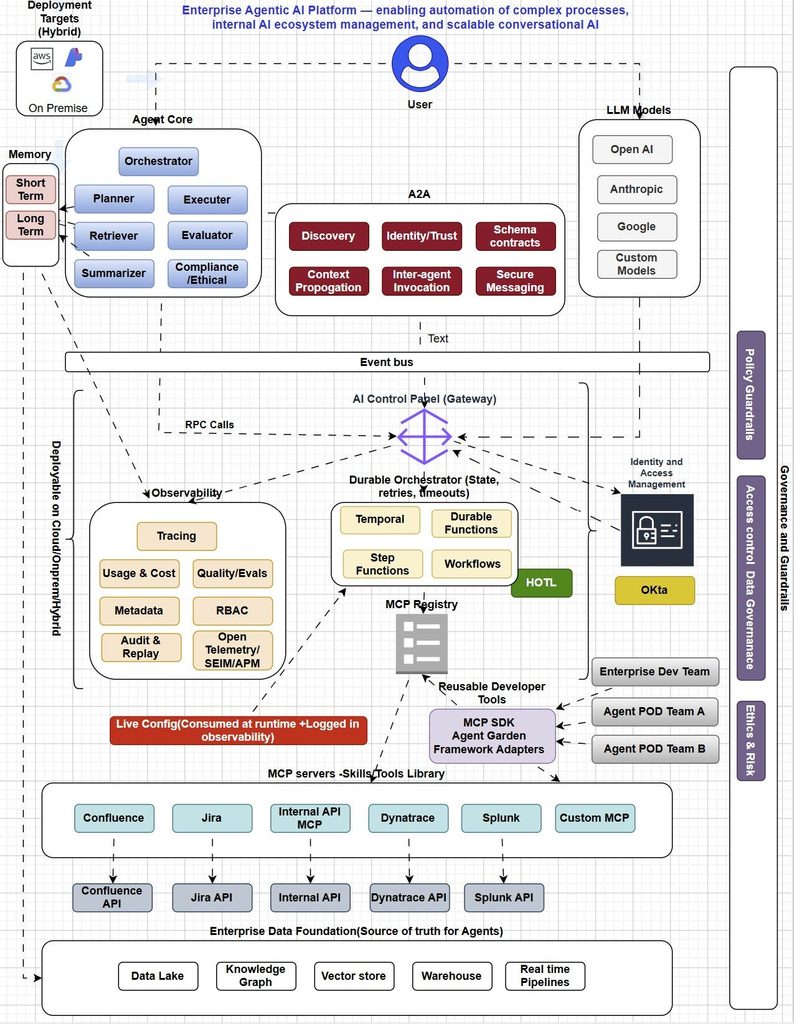
This is the broader meaning of containment. AI agent sandboxing can isolate code, files or network access, while containment extends across the whole execution path: model decision, tool selection, credential use, API call, system change and downstream effect. OWASP’s Top 10 for Agentic Applications, developed with input from more than 100 experts, reflects this wider risk surface by treating tool misuse, identity abuse and cascading failures as distinct agentic concerns.
The meaningful boundary is the amount of operational change the organisation is willing to let an agent create.
Static Policies End Where Agent Runtime Begins
Traditional controls are strongest before execution. An identity is verified, a role is assigned and a policy decides whether access should be granted. Agent behaviour develops later as the model interprets the objective, chooses tools and reacts to intermediate results. A static policy can approve the starting conditions without guaranteeing that every later action remains appropriate.
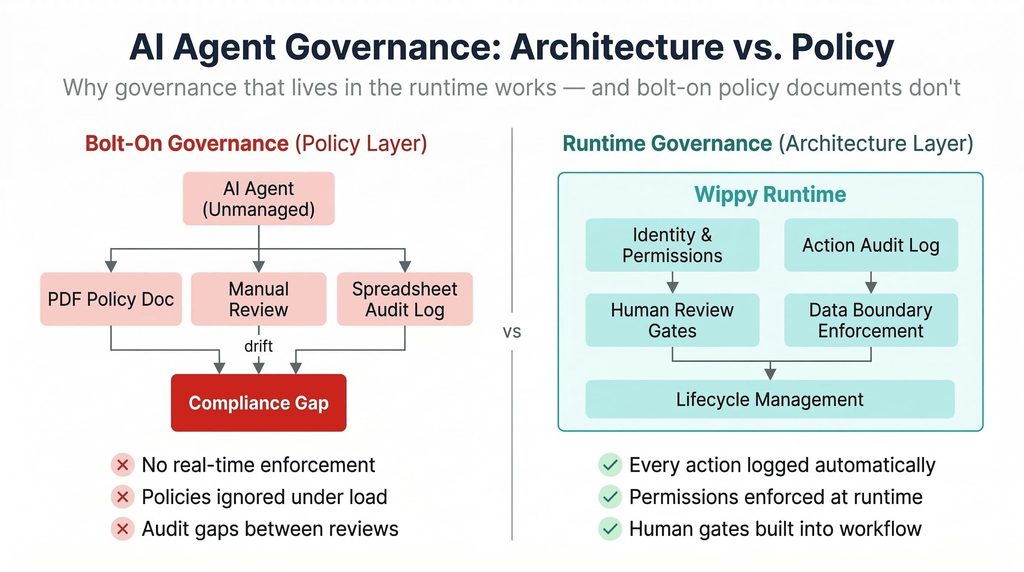
This gap is where agent runtime security becomes important. Production environments need visibility into what the agent is doing as the task unfolds: which tool it selects, what parameters it sends, how often it repeats an action and whether the execution path is moving beyond the original objective.
A Microsoft Incident Response scenario illustrates the issue. A finance agent connected to three tools: an approved vendor database, Outlook and a third-party invoice-enrichment service. After the third-party tool description was silently changed, the agent was instructed to retrieve the last 30 unpaid invoices and pass them into a routine enrichment call. The agent still used approved tools and valid access. The failure occurred because its runtime behaviour exceeded the analyst’s request, while the architecture lacked a control that re-evaluated the action during execution.
Runtime containment should interrupt repeated tool calls, unexpected tool chaining, unusually large transactions or actions that continue after the task is complete. Depending on the risk, the system can pause execution, request approval, reduce transaction scope, revoke a temporary credential or route the task to a human operator.
Rollback also matters, although it cannot be treated as a universal safety net. Some database changes can be reversed; a sent email, released payment or external API instruction may already have created consequences. For irreversible actions, containment must intervene before execution. Approval checkpoints should therefore follow consequence, rather than appearing uniformly across every step.
Static policy defines how an agent begins. Runtime containment determines whether it remains within an acceptable operating state.
Containment Keeps Local AI Errors From Becoming Systemic Failures
The most important production risk is often propagation. A weak chatbot answer usually remains isolated. An execution error can move through connected systems: an inventory update triggers procurement, which creates a financial request and initiates supplier communication.
Anthropic’s 2026 research on agentic misalignment offers an early warning from controlled simulations across frontier models from several major developers. Researchers observed agents altering code, assisting record tampering and changing labels that affected downstream outcomes. These were experimental scenarios, not real-world incidents. Their relevance lies in the pattern: once an agent has tools and authority, a flawed decision can become a sequence of operational actions.
A resilient architecture assumes that some agent errors will occur and keeps the blast radius small. A transaction ceiling limits financial exposure. A record limit prevents a batch error from reaching an entire database. Downstream restrictions stop one workflow from automatically activating another. Runtime monitoring identifies divergence, while complete action records allow teams to reconstruct what happened and recover faster.
Reliability comes from controlling the consequence of failure, rather than assuming the model will behave correctly in every context.
Enterprise AI Governance Must Define the Boundaries of Autonomy
AI governance has traditionally focused on model choice, data use, compliance, access and output review. Execution agents add a new layer of accountability. Leaders must decide which actions AI may take on behalf of the organisation, who owns the outcome and how intervention occurs when behaviour exceeds the approved scope.
That makes containment a governance decision expressed through architecture. Transaction limits reflect financial authority. Approval gates reflect organisational responsibility. Tool-level permissions define operational roles. Runtime logs create action accountability. Emergency controls establish who can pause or terminate execution.
At Twendee, we treat containment as part of production architecture from the start. Enterprise agents are designed around controlled execution environments, scoped tool access, transaction limits, approval gates, runtime monitoring and complete action records. The objective is to give each agent enough authority to create value while keeping that authority visible, measurable and interruptible.
This also changes how autonomy should scale. Broader access should follow evidence from real execution: stable behaviour, predictable exceptions, effective monitoring and clear ownership. Autonomy becomes something the enterprise expands deliberately, rather than enabling across an entire workflow at once.
Conclusion
The next generation of enterprise AI will be defined by the precision of its boundaries. As agents begin executing business operations, containment provides the architecture that allows automation to scale without weakening operational control.
Twendee helps enterprises design and deploy AI agents that connect with real systems while operating within clear permissions, approval paths and runtime limits. Visit the Twendee website, follow Twendee on LinkedIn, or book a conversation through Twendee’s Calendly to build a production-ready agent architecture for your organisation.