
Cloud cost planning used to be difficult but predictable. Teams could estimate compute, storage, traffic, and SaaS usage based on historical patterns. AI workloads change that model.
Training runs, inference spikes, vector databases, retrieval pipelines, GPU capacity, and agentic workflows create cost behavior that does not scale like traditional applications. A normal SaaS feature may trigger one backend request. An AI feature may trigger retrieval, prompt construction, model inference, validation, logging, and multiple tool calls behind one visible user action.
That is why AI cloud cost is becoming a board-level concern. For CTOs and finance teams, the problem is no longer only cloud spending. It is whether AI usage can scale without turning into an uncontrolled infrastructure cost.
Why AI cloud cost is harder to forecast than traditional cloud spend
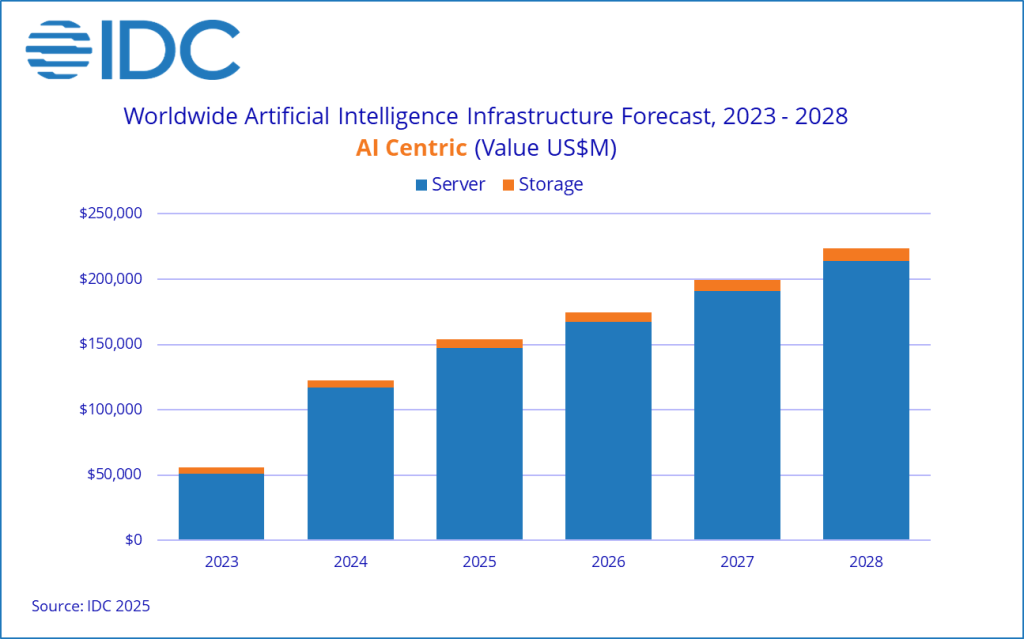
Traditional cloud workloads usually grow with familiar business signals: users, transactions, storage volume, traffic, or application activity. AI workloads behave differently. One product feature can multiply inference calls. A larger context window can raise cost without changing the number of users. An AI agent can perform several hidden steps before producing one answer.The infrastructure pressure is already visible. IDC forecasts AI infrastructure spending will reach USD 758 billion by 2029, with accelerated servers accounting for 94.3% of total spending. IDC also reported that the United States represented 76% of global AI infrastructure spending in Q2 2025, showing how concentrated and intense the AI compute buildout has become. (IDC)
McKinsey frames the scale even more sharply. It estimates that data centers will require USD 6.7 trillion in global capital expenditure by 2030 to keep pace with compute demand, including USD 5.2 trillion for AI-ready data centers and USD 1.5 trillion for traditional IT workloads. (McKinsey)
For enterprises, these numbers matter because infrastructure pressure eventually flows into cloud pricing, capacity planning, vendor contracts, and internal cost allocation. AI does not only increase spending. It changes the shape of spending.
The forecasting challenge usually appears in three ways:
- Training and experimentation are irregular: Fine-tuning, evaluation, testing, and data preparation can create short but expensive compute bursts.
- Inference grows with adoption: Once AI features reach real employees or customers, cost scales with every interaction.
- Agentic workflows hide cost steps: One request can trigger multiple model calls, retrieval tasks, API actions, validation checks, and database operations.
This is where FinOps for AI becomes different from traditional cloud cost management. Traditional FinOps asks where cloud money is going. FinOps for AI also asks why a model, workflow, or agent is consuming resources, whether that usage improves business value, and where architecture can be redesigned before cost becomes structural.
How AI workloads expose the limits of cloud cost management
Cloud cost management has improved over the past decade. Many companies already use tagging, budgets, reserved instances, autoscaling, rightsizing, alerts, and FinOps dashboards. These practices still matter. The issue is that AI introduces cost signals that older models were not designed to explain.
Flexera’s 2026 State of the Cloud report found that wasted cloud spend rose to 29% after five years of decline, reflecting growing cost complexity from AI and newer IaaS and PaaS services. This is important because AI rarely enters a clean cloud environment. It often lands on top of existing cloud waste, fragmented ownership, and imperfect cost visibility.
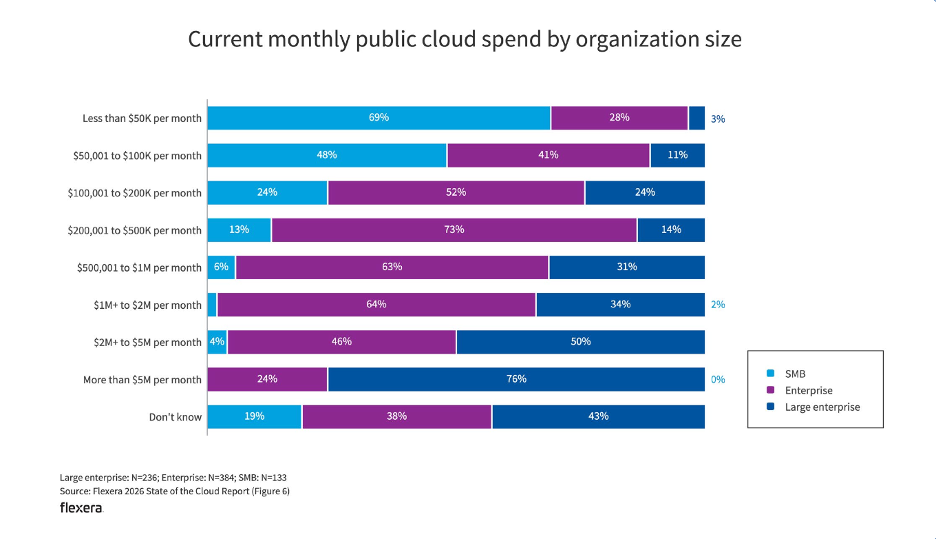
Flexera’s cloud spending breakdown also shows that larger organizations are far more likely to operate at high monthly public cloud spend levels, which makes AI workload visibility even more urgent before usage scales.
1. AI costs are shared, so ownership becomes unclear
A traditional workload can often be mapped to one team, application, environment, or customer segment. AI infrastructure is harder to allocate. A shared model endpoint may support customer support, sales, internal search, product features, and analytics. A vector database may serve several departments at once. GPU capacity may be used by data science, product engineering, and experimentation teams.
When ownership is unclear, accountability weakens. Engineering may see AI usage as product innovation. Finance may see unpredictable infrastructure growth. Product leaders may see customer value but lack unit economics. Everyone benefits from the shared AI layer, but no one fully owns the cost behavior.
For AI cloud cost planning, allocation needs to move beyond generic tagging. Enterprises need to connect AI spend to business units, products, workflows, customers, environments, and model usage. Without that visibility, cloud cost management becomes reactive. Teams only notice the problem after the bill arrives.
2. AI unit economics are harder to define
Traditional cloud unit economics often rely on metrics such as cost per user, cost per API request, cost per transaction, or cost per workload. AI needs more specific measures because the business value depends on the use case.
A support AI should not be measured the same way as a document intelligence system, an ERP assistant, or an internal analytics agent. The useful metric might be cost per resolved ticket, cost per generated report, cost per automated workflow, cost per successful agent task, or cost per customer interaction.
The key is to connect infrastructure cost to the outcome the AI workload is supposed to improve. If a support AI costs more but reduces escalation time, improves resolution quality, and lowers human workload, the cost may be justified. If an AI assistant generates thousands of expensive calls without improving decisions or reducing manual work, the cost is simply hidden waste with a modern interface.
3. AI optimization must happen at the architecture level
Many cloud optimization programs focus on infrastructure after deployment. For AI, that is often too late. Once a model choice, retrieval flow, or agent workflow is embedded into a product, cost behavior becomes harder to change.
A model may be too large for the task. Retrieval may fetch too much context. A workflow may call the model too often. Agents may take too many steps. Logs may store unnecessary data. Caching may be missing. Batch processing may not be used where real-time response is unnecessary.
These are architecture decisions, not only finance decisions. Infrastructure cost control needs to shift earlier into system design. Teams should ask whether the workload can use smaller models, cached outputs, asynchronous processing, cheaper storage tiers, model routing, workload scheduling, or hybrid infrastructure before usage scales.
What FinOps for AI should look like before costs become uncontrolled
The old cloud cost playbook is not useless. It is incomplete. Enterprises still need visibility, budgeting, ownership, optimization, and governance. But FinOps for AI needs to become more workload-aware, model-aware, and outcome-aware.
A stronger FinOps for AI model should start with four operating principles.
- Make AI cost visible at the workflow level: AI spend should not appear only as model usage, GPU cost, or cloud service cost. It should be mapped to workflows such as support resolution, document processing, ERP approvals, code review, sales follow-up, fraud detection, reporting, or internal search. This helps leaders see where AI creates value and where it only increases consumption.
- Separate experimentation from production: AI experimentation should have sandbox environments, budget limits, and clear approval thresholds. Production AI workloads need stronger monitoring, reliability, security, and cost controls. Mixing the two creates noisy forecasts because experimental spikes distort the baseline.
- Track model and infrastructure choices together: A model decision is also a cost decision. Larger models, longer context windows, frequent retrieval, real-time inference, and multi-agent workflows all affect infrastructure needs. Cost planning should therefore include model selection, prompt design, caching strategy, workload routing, and data architecture.
- Align engineering, finance, and product ownership: Microsoft describes FinOps as a discipline that combines financial management principles with cloud engineering and operations to help organizations understand and manage cloud spending. For AI, that collaboration becomes even more important because finance alone cannot judge model architecture, while engineering alone may not see margin impact.
This is where Twendee’s role fits naturally. Twendee helps companies design cloud architecture with cost visibility, scalable infrastructure planning, and AI workload control in mind. That includes optimizing enterprise systems for AI workloads, designing integration layers that avoid duplicated processing, and building operational platforms where AI usage can be monitored against real business workflows.
The goal is not to reduce AI usage for the sake of saving money. The goal is to prevent AI adoption from becoming financially blind. AI should scale because it creates measurable operational value, not because infrastructure spend is growing faster than the organization can explain.
How enterprises can control AI cloud cost without slowing innovation
Cost control should not become a blocker for AI innovation. The better approach is to make cost part of design quality. A well-designed AI system should be accurate, secure, scalable, and economically understandable.
For CTOs, this means architecture decisions need cost observability from the beginning. For CFOs, AI budgets should be tied to unit economics, not only monthly cloud totals. For product teams, every AI feature should have a cost model before adoption scales.
A practical roadmap starts with visibility. Enterprises need to know which AI workloads exist, who owns them, what infrastructure they use, what business outcome they support, and how cost changes with usage. From there, teams can optimize based on value instead of reacting to cloud bills.
An internal AI assistant used by 30 employees may not need the same model, latency, or infrastructure as a customer-facing AI feature used thousands of times per day. A reporting assistant may run asynchronously at lower cost. A document extraction workflow may use batch processing. A customer-facing agent may require stricter performance but stronger guardrails around step count, context size, and tool calls.
This is the real discipline behind AI cloud cost management: matching infrastructure choices to the workload’s business value.
Conclusion
AI workloads are breaking old cloud cost planning models because they scale in ways traditional applications do not. Training cycles are irregular, inference demand can surge quickly, agentic workflows multiply hidden steps, and shared AI infrastructure makes ownership harder to assign.
This is why AI cloud cost planning must evolve into a stronger FinOps for AI discipline. Enterprises need visibility before usage scales, architecture designed for cost control, and financial models that connect AI spend to business outcomes.
For companies preparing to scale AI responsibly, Twendee helps design cloud architecture, enterprise systems, and AI workload environments that support innovation without unnecessary infrastructure waste.
Book a call: Calendly
Read latest blog: Automation Breaks When Workflows Are Poorly Defined