
Shadow AI is not spreading because employees have suddenly become careless with enterprise security. It is spreading because AI became useful faster than most organizations made it governable.
Employees use generative AI to summarize documents, draft communications, analyze information, and write code. The question is no longer whether AI will enter the enterprise, but whether that adoption will remain invisible or become part of a trusted operating environment.
AI Adoption Has Shifted From IT-Led to Employee-Led
Traditional enterprise technology usually entered the organization through a controlled sequence: business need, IT review, procurement, security assessment, and deployment. Generative AI reversed that sequence. Employees discovered the tools first, experienced immediate productivity gains, and incorporated them into daily work before many companies had a formal AI strategy.
The scale of this shift was already visible in Microsoft and LinkedIn’s 2024 Work Trend Index. Based on a survey of 31,000 people across 31 countries, it found that 75% of knowledge workers were using AI at work, while 78% of AI users were bringing their own tools into the workplace. More than half were also reluctant to admit using AI for their most important tasks. That combination, high adoption and low visibility, captures the governance challenge more clearly than adoption figures alone.
In the same study, 90% said AI saved time and 85% said it helped them focus on their most important work. To employees, an accessible AI assistant feels less like a new system and more like a faster way to complete a task.

This changes the role of IT. Instead of deciding whether AI enters the organization, IT increasingly has to govern technology that is already there. The issue is not that people use AI. It is that leaders may not know where it is used, which business data enters it, or how its outputs affect decisions.
AI is entering organizations faster than governance can keep up.
Shadow AI Is Repeating the Shadow IT Pattern—At a Much Faster Pace
The pattern is familiar. Long before generative AI, employees adopted personal cloud storage, messaging apps, and SaaS tools when official systems were too slow or inconvenient. Shadow IT emerged from the gap between how work was supposed to happen and how employees found it easiest to work.
Shadow AI follows the same logic. It refers to AI tools, models, accounts, or features used outside an organization’s approved oversight. Yet it spreads faster than traditional Shadow IT because the barrier to adoption is lower. A browser tab, personal account, extension, or embedded AI feature may be enough to place a new model inside a business workflow.
The Netskope Cloud and Threat Report 2026 found that the number of people using SaaS generative AI applications had tripled over the previous year and prompt activity had increased sixfold. Although enterprise-managed adoption was growing, 47% of generative AI users were still using personal AI applications.
Counting approved tools therefore gives executives an incomplete picture. Shadow AI can also exist inside familiar software, custom cloud applications, or locally deployed models that never pass through procurement.
The technology has changed, but the organizational pattern has not. Employees move toward the most useful path, while governance arrives later.
Shadow AI is therefore not primarily an AI problem. It is an organizational visibility problem.
The Biggest Shadow AI Risk Is Unmanaged Business Data
Executive discussions often reduce Shadow AI risk to privacy, security, compliance, and inaccurate outputs. Those concerns are valid, but they are symptoms of a deeper issue: business data is moving into systems the organization cannot observe or control.
An employee may paste source code into an assistant, upload a contract for summarization, or provide an internal report as context. At scale, these actions create an undocumented data layer outside the approved architecture.
Netskope reported that detected generative AI data-policy violations doubled during 2025, reaching an average of 223 incidents per organization each month. Source code represented 42% of those incidents, regulated data 32%, and intellectual property 16%. More importantly, 50% of organizations lacked enforceable data-protection policies for generative AI applications, suggesting recorded incidents may reveal only part of the exposure.
The 2023 Samsung incident showed how quickly a productivity shortcut can become a governance event. According to Reuters’ reporting on workplace ChatGPT use, Samsung restricted employee access to generative AI tools after discovering that an employee had uploaded sensitive code. The company also said it was reviewing how to provide a secure environment without losing productivity benefits.
The cost is not limited to a possible leak. It includes weak traceability and unclear accountability. Once AI-generated content enters a report, codebase, customer interaction, or operational decision, the organization may be unable to determine which model produced it, what data was provided, whether the output was reviewed, or who accepted the associated risk.
IBM’s 2025 Cost of a Data Breach Report found that 63% of surveyed organizations lacked AI governance policies, while 97% of organizations reporting an AI-related security incident lacked proper AI access controls.
Governance becomes harder because organizations cannot protect, audit, or explain what they cannot see.
Blocking AI Rarely Works. Governance Must Be Built Into Everyday Workflows
A blanket ban may reduce exposure temporarily, but it does not remove the business demand that created Shadow AI. Restriction without a usable alternative can push adoption further out of sight.
A stronger approach is to make the approved path more practical than the unmanaged one. This requires more than purchasing an enterprise chatbot. Governance has to connect identity, data, permissions, and the workflow in which AI is used.
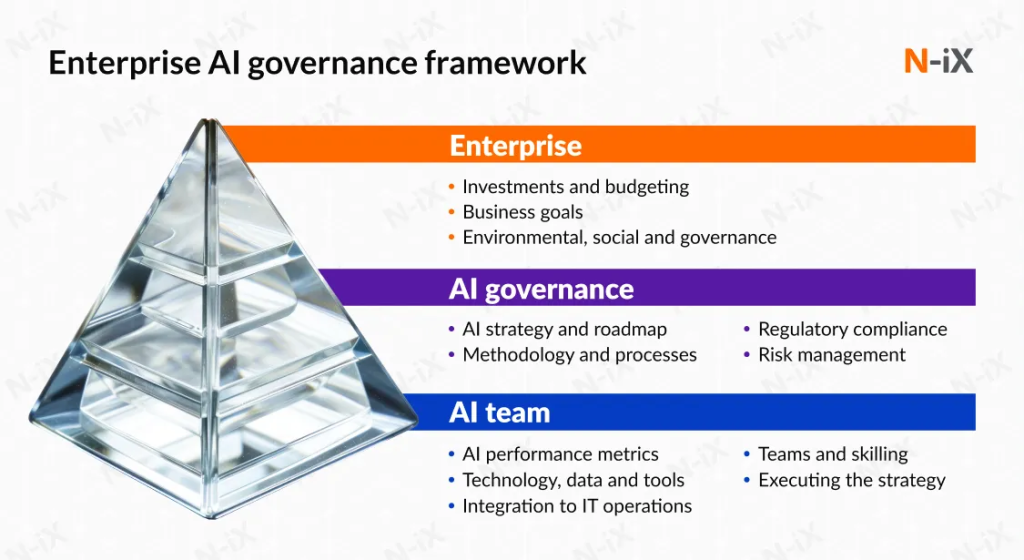
A trusted enterprise AI environment should provide:
- Approved platforms connected to corporate identity
- Role-based access to data and business actions
- Policy enforcement for sensitive information
- Audit trails showing how AI is used and where outputs go
Workflow-level governance matters. A writing assistant may be acceptable for improving public marketing copy but inappropriate for reviewing a confidential customer agreement. The same model can present very different risks depending on the data, user, purpose, and downstream action.
This is where traditional tool approval becomes insufficient. A company cannot classify one AI platform as universally “safe” without considering how it is connected to enterprise systems and what users are permitted to do with it. Governance must travel with the workflow rather than remain in a policy document that employees consult only after a problem occurs.
JPMorgan Chase offers a useful example of replacing unsanctioned demand with a governed alternative. Its internal LLM Suite gives employees access to large language models in a secure environment and reportedly grew from zero to 200,000 onboarded users within eight months.
The lesson is not that every enterprise needs to build its own model. It is that adoption becomes easier to govern when employees receive a credible, integrated alternative.
At Twendee, this principle informs how enterprise AI environments should be designed. Access control, data governance, workflow orchestration, monitoring, and human approval need to work together. AI should connect to approved ERP, CRM, knowledge, and operational systems rather than depend on employees manually moving data between disconnected tools.
Effective governance does not slow AI adoption. It replaces unmanaged adoption with a trusted operating environment.
AI Success Will Depend More on Governance Than Model Quality
For the first phase of enterprise AI, the market focused heavily on model capability. The next phase is less about isolated performance and more about operational trust.
Models are increasingly accessible through SaaS products, cloud platforms, APIs, and open-source deployments, while AI agents are moving closer to enterprise data and gaining the ability to act across systems. Netskope’s research on Shadow AI and agentic AI found that Shadow AI represented the majority of enterprise AI use in its observed environments, while custom platforms, on-premises deployments, and agents were creating new visibility challenges.
As AI becomes embedded in operations, model quality remains important-but it is no longer sufficient. Competitive advantage will increasingly depend on whether an organization can combine trusted enterprise data, identity, governance, integration, orchestration, monitoring, and human accountability.
An advanced model operating outside business controls may create impressive demonstrations without durable value. A well-governed system connected to the right data and workflow can create repeatable value even when it does not use the most powerful model available.
The organizations that benefit most from AI will not necessarily be those using the largest number of tools or the most advanced models. They will be the ones that make AI trustworthy enough to become part of everyday operations.
Conclusion
Shadow AI is becoming the new Shadow IT because employee demand is moving faster than enterprise oversight. The answer is not to treat employees as the problem or rely on broad restrictions. It is to build a governed environment where useful AI is accessible, data remains controlled, and important actions can be traced.
Twendee helps enterprises design and integrate secure AI solutions around real business workflows – from access control and data governance to system integration, orchestration, and monitoring. Visit the Twendee website, follow Twendee on LinkedIn, or book a conversation through Twendee’s Calendly.