

Most companies can explain what they spend on cloud infrastructure and business software. Far fewer can explain what they actually spend on AI—or which part of that spending creates measurable business value.
That gap is becoming an AI cost visibility problem. The invoices exist, but AI consumption is spreading across tools, teams, models, and workflows faster than organizations can connect it to operational outcomes.
AI Cost Visibility Is Disappearing Into Everyday Operations
AI spending rarely sits in one budget line. It is scattered across productivity tools, developer assistants, model APIs, cloud infrastructure, internal agents, and department-led experiments. Each transaction may be visible, but the enterprise view remains incomplete because costs sit under different vendors, teams, and cost centers.
This reflects a deeper shift. AI spending is becoming operational spending rather than conventional software spending. Traditional software is tied to licenses and renewal cycles. AI costs increasingly follow activity: prompts processed, model calls made, documents reviewed, code generated, or automated actions completed.
According to McKinsey’s 2025 State of AI survey, 78% of respondents said their organizations used AI in at least one business function, up from 55% a year earlier.
AI spending is becoming cross-functional before many companies have built a cross-functional way to manage it. Reconciling invoices is no longer enough. Leaders need to know which workflow created the cost, who owns the result, and whether higher consumption represents valuable scale or uncontrolled activity.
AI Cost Visibility Gets Worse as AI Adoption Grows
The usual assumption is simple: more AI adoption should create more productivity. Operationally, each new use case also creates another path through which spending and accountability can become disconnected.
One team buys an AI assistant while another pays for a similar capability. Developers access the same model through several platforms. Employees keep using personal tools after an enterprise solution is introduced. Pilots may continue consuming resources after the project ends.
The result is duplicated functionality, more experiments, and more shadow AI outside procurement and governance.
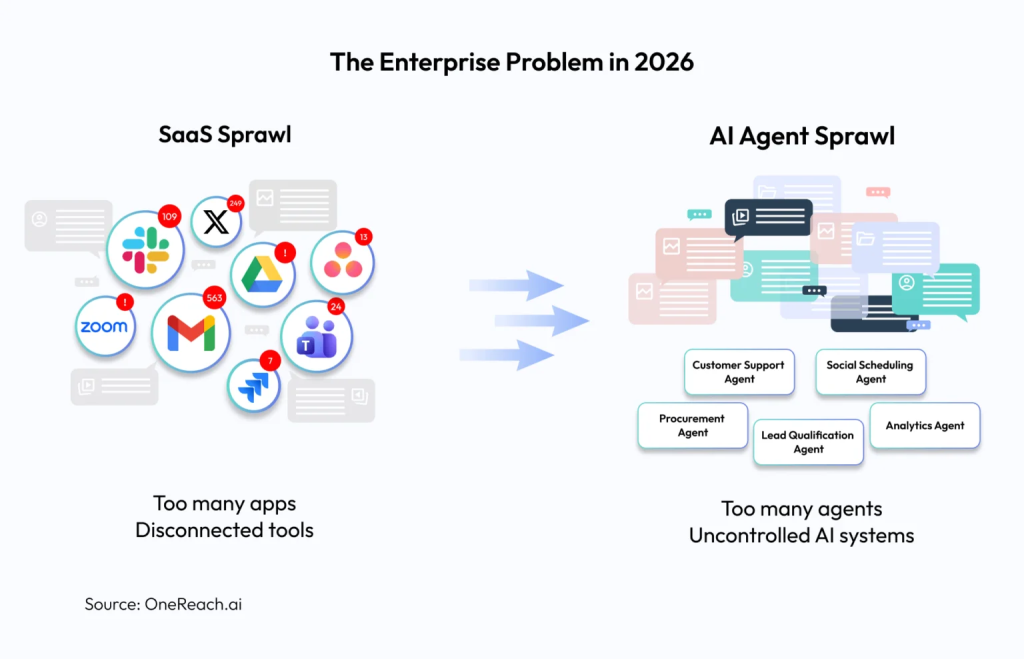
The Microsoft and LinkedIn 2024 Work Trend Index found that 78% of AI users were bringing their own AI tools into the workplace, while 59% of leaders were concerned about quantifying AI productivity gains. Adoption can accelerate at employee level while enterprise visibility falls behind.
The State of FinOps 2026 report found that 98% of respondents managed AI spending, up from 31% two years earlier, yet visibility, allocation, and ROI determination remained major concerns.
The visibility problem can therefore scale faster than AI adoption itself. Centralized purchasing may reduce duplicate licenses, but it cannot show whether an AI-enabled workflow improved performance. Real visibility must extend beyond what the company bought to how AI is used inside operations.
AI Cost Visibility Must Connect Spending With Business Value
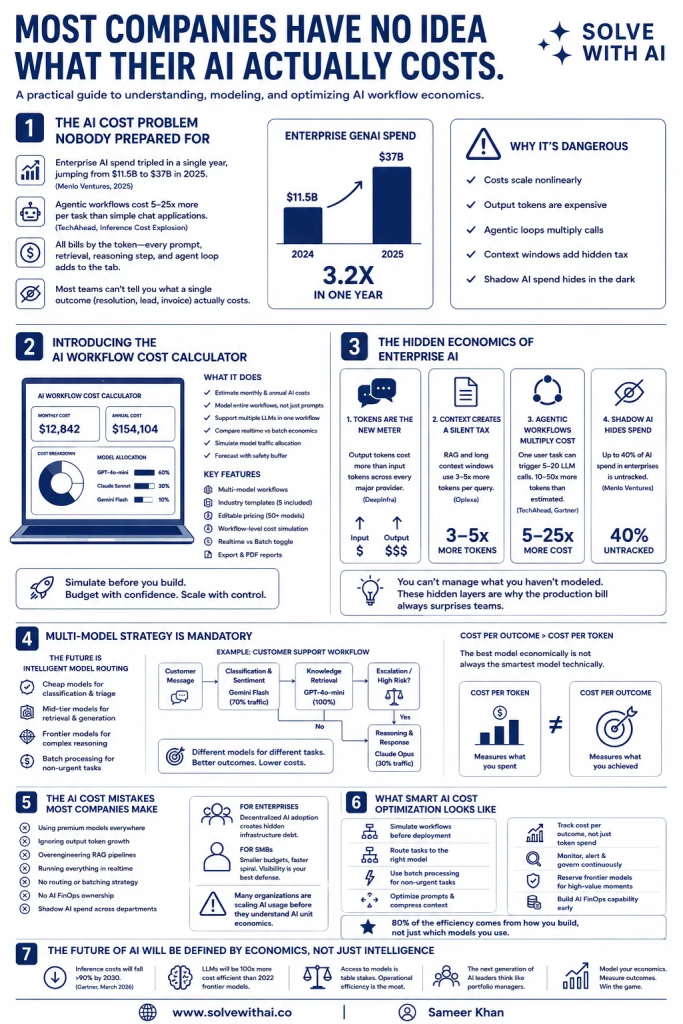
Most AI cost reporting begins with what is easiest to measure: tokens, API calls, compute usage, and licenses. These metrics are useful, but they measure consumption rather than contribution.
The same model usage could support a high-value decision or power an agent that performs unnecessary steps. Technical usage becomes meaningful only when linked to the work being performed.
Companies often compare total AI spending with broad outcomes such as revenue or productivity, even though those results are influenced by many factors. A more useful unit of analysis is the workflow.
Instead of reporting that marketing spent $5,000 on AI, the company should know whether that investment reduced campaign production time, increased qualified leads, or enabled more output without additional headcount. In customer service, the relevant measure may be AI cost per resolved ticket alongside response time.
The objective is not to create a complex financial model for every use case. It is to measure cost and outcome at the same operational level.
That distinction helps leaders separate two very different situations:
- AI usage is rising because a valuable workflow is scaling.
- AI usage is rising without any measurable improvement in the process.
According to IBM’s 2025 CEO Study, surveyed CEOs said only 25% of AI initiatives had delivered expected ROI, while 16% had scaled enterprise-wide. Half also said rapid technology investment had created disconnected systems.
McKinsey similarly found that fewer than one in five respondents tracked clearly defined KPIs for generative AI solutions, even though KPI tracking showed the strongest relationship with bottom-line impact.
These findings do not necessarily mean AI is failing to create value. They suggest many organizations lack the attribution needed to prove it. Enterprises do not have an AI ROI problem first. They have an attribution problem.
Until spending can be linked to a workflow, and that workflow to an outcome, returns will remain difficult to defend.
AI Cost Visibility Has to Be Designed Into the Workflow
Many organizations add visibility after deployment. They launch a tool and build reporting only when spending attracts attention. By then, the context needed to understand the cost may already be missing.
AI visibility has to be designed into the workflow from the beginning. An AI-enabled process should capture more than model usage and technical cost. It should also record which process triggered the activity, who owns it, what result was expected, and whether that result occurred.
No single function has the whole picture. Cloud teams see technical cost, finance sees budget variance, and business teams see operational value. These perspectives need to meet around one shared unit: the workflow.
Every production use case should have a defined operational purpose, whether faster cycle time, higher throughput, lower error rates, improved conversion, or reduced manual intervention. Without a defined outcome, growing usage can easily be mistaken for success.
McKinsey found that workflow redesign had the strongest relationship with EBIT impact from generative AI, while only 21% of organizations using the technology said they had fundamentally redesigned at least some workflows.
This is the approach Twendee applies when building enterprise AI systems. Rather than treating monitoring as a separate layer, Twendee connects model and agent activity with workflow ownership, cost attribution, and operational measurement. The goal is not another dashboard, but an AI system whose value can be traced while it operates.
AI Cost Intelligence Will Define the Next Stage of Enterprise AI
Enterprise AI began with access, then moved to adoption. The next stage will be about intelligence—whether leaders can make better investment decisions from a clear relationship between AI spending and business performance.
The goal is no longer simply to reduce token costs or consolidate vendors. Spending less does not automatically mean creating more value.
The distinction is important:
- AI cost visibility explains where the money goes.
- AI cost intelligence helps leaders decide what to do next.
It supports decisions about which use cases should scale, which models should change, which workflows require redesign, and which experiments should end.
The companies that gain the most from AI will not necessarily have the lowest AI bill. They will be those that can explain why spending increased, what operational result changed, and whether that result justifies further investment.
Conclusion
AI spending is becoming harder to see because AI is becoming part of everyday operations. Tracking invoices, tokens, and licenses is necessary, but not enough. Sustainable AI adoption requires a direct connection between consumption, workflow ownership, and measurable outcomes.
Twendee helps enterprises build that visibility into AI systems from the start—from usage tracking and workflow-level cost attribution to integration and performance measurement. Visit the Twendee website, follow Twendee on LinkedIn, or book a conversation through Twendee’s Calendly.