
Companies can now generate forecasts, alerts, summaries, and AI recommendations in minutes. Yet important decisions still wait in approval queues, meetings, email threads, and unclear ownership chains. This gap reveals a limit of AI decision making. AI can reduce the time needed to understand a situation. However, it does not automatically reduce the time needed to choose, approve, and act.
A model may flag declining margins before the monthly review. A customer-risk alert may appear as soon as account activity changes. An inventory forecast may identify a shortage weeks earlier. Still, the response can stall if no one owns the decision or if every action requires the same approval path.
The real bottleneck often begins after the insight appears. AI creates operational value only when information can move through a defined workflow with clear ownership, suitable controls, and an executable next step.
Why Faster AI Insights Still Produce Slow Decisions
Most organizations measure how quickly information becomes available.
They track report generation, dashboard refresh rates, forecasting accuracy, and the time analysts save. These metrics matter. However, they describe only the information stage of decision-making.
A business may understand a problem quickly and still respond slowly.
Consider a product line with falling margins. An AI system may identify the decline, compare cost changes, and highlight the accounts most affected. Finance may confirm the numbers within hours.
The decision can still stop there.
Sales may want more customer context. Operations may need to check delivery capacity. Pricing may require commercial approval. Leadership may request another forecast. Meanwhile, no team clearly owns the final call.
The analysis was fast. The organization was not.
This distinction matters because companies often treat decision delays as a data problem. They invest in another dashboard or analytics layer, even when the real delay comes from unclear authority, repeated reviews, or disconnected workflows.
McKinsey’s research on faster decision-making argues that better decisions depend on clear processes, the right level of participation, and stronger commitment to execution. In other words, more information does not compensate for a weak decision structure.
Some delay is necessary. Financial, legal, regulatory, and customer-sensitive decisions need review. The problem is not control itself. The problem is applying control without clear decision rights or risk-based routing.
This creates a growing gap inside many enterprises: Information latency is falling faster than organizational decision latency.
AI makes that gap easier to see. It can surface a recommendation in seconds while the organization still needs days to decide what to do with it.
Where Enterprise Decision Bottlenecks Actually Sit
The main obstacle to faster enterprise decision-making is rarely one slow meeting or one missing dashboard.
It is usually the full path between signal, ownership, approval, execution, and feedback.
Ownership is distributed, but accountability is not
Enterprise decisions often involve several roles.
The data team may produce the insight. Operations understands the workflow. Finance controls the budget. A manager holds approval authority. Another team completes the action.
These roles are useful, but they are not interchangeable.
A data owner maintains the information. A process owner manages how work moves. An approver confirms that a condition has been met. A decision owner is accountable for choosing the outcome. An execution owner carries out the next step.
When these responsibilities are unclear, everyone can contribute without anyone closing the decision.
For example, an AI model may flag that a customer account has a high risk of churn. Sales owns the commercial relationship. Customer success knows the recent complaints. Finance understands the account value. Product knows whether a requested feature is feasible.
All four teams may discuss the case. Yet the company still needs one person with the authority to choose the response.
More stakeholders can improve decision quality. However, undefined authority usually increases decision time.
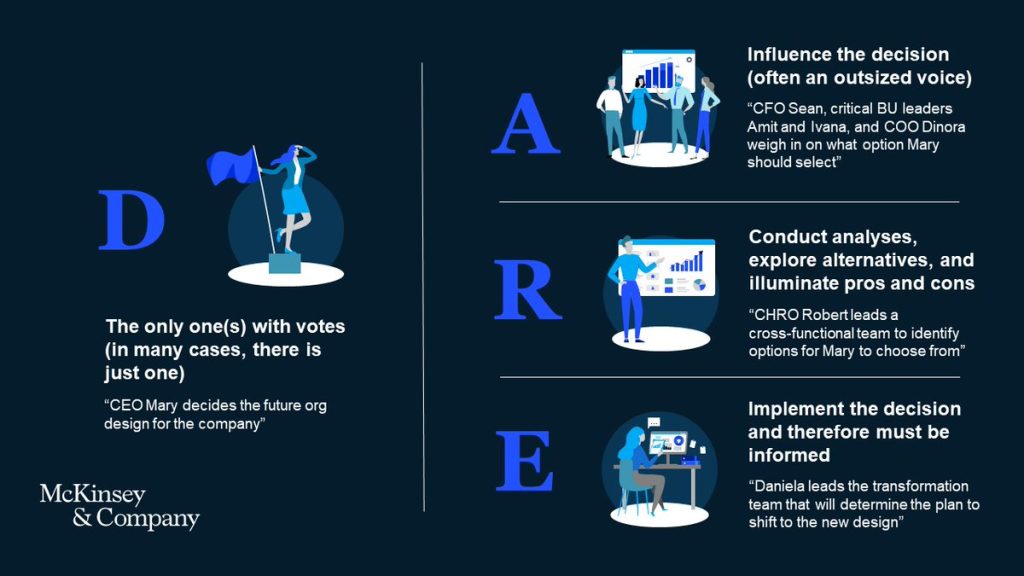
McKinsey’s work on decision rights warns that broad responsibility frameworks can create ambiguity when they fail to identify the real decision maker. A useful structure must show who provides input, who decides, and who drives execution.
Approval logic does not reflect risk
Many companies use one approval chain for several different types of decisions.
A small pricing exception may follow the same route as a major commercial commitment. A routine operational adjustment may require the same leadership review as a regulated or high-value decision.
This creates two problems.
First, low-risk decisions wait longer than necessary. Second, senior leaders spend time reviewing matters that teams could resolve within clear limits.
A stronger workflow routes decisions using factors such as:
- Financial value
- Customer impact
- Operational risk
- Compliance sensitivity
- Confidence in the available evidence
- Whether the action can be reversed
A low-risk and reversible decision may proceed within predefined guardrails. A high-value or sensitive case may require additional review.
This model does not remove control. It places control where it creates the most value.
AI can support risk classification and detect missing evidence. However, the business must define the thresholds and decision authority first. AI cannot create legitimate approval rights on its own.
AI insights sit outside the operational workflow
Many AI insights appear in separate dashboards, reports, or analytics tools.
The manager sees the recommendation. Then the real work begins.
They may need to open CRM, find the relevant account, check the latest customer note, message the owner, request approval, update another platform, and track the outcome manually.
The insight arrived quickly, but it remained isolated from execution.
This is one of the most important weaknesses in enterprise AI adoption. Companies improve the intelligence layer without redesigning the operational path that follows it.
An AI alert becomes more useful when it appears inside the relevant workflow with the business context, accountable owner, approval requirement, and suggested next action.
For example:
- A sales-risk alert should connect to the CRM opportunity and account owner.
- A budget anomaly should route into the correct finance workflow.
- An inventory warning should link to replenishment rules and approval limits.
- A delivery-risk signal should appear inside the project record with its current owner.
The 2025 MuleSoft Connectivity Benchmark found that data integration remains one of the largest barriers to implementing AI across enterprise systems. The underlying problem is structural: an insight cannot support a complete decision when the relevant data, workflow, and business rules remain separated.
An AI insight becomes operationally useful only when it arrives with context, ownership, and a defined next action.
No feedback loop connects the decision to the outcome
Many organizations can show what the AI recommended. Fewer can show what happened afterward.
They may not consistently capture:
- Whether the recommendation was accepted
- Who changed or rejected it
- Why another option was chosen
- How long the decision took
- Which action followed
- Whether the result improved
Without this feedback loop, teams cannot tell whether the bottleneck came from the model, the data, the workflow, the approval chain, or the execution.
The system should record the complete path:
Signal → recommendation → decision owner → approval → action → outcome
This creates accountability and better learning data.
For example, an AI system may repeatedly recommend escalating a certain type of customer case. Managers may reject the recommendation because the account profile lacks recent support context.
That pattern is valuable. It shows that the next improvement should focus on data integration rather than model tuning.
IBM’s guidance on AI governance emphasizes guardrails, monitoring, accountability, and traceability across AI systems. In operational decision-making, those controls should cover not only the recommendation but also the workflow that turns it into action.
The real decision system is not the AI model.
It is the full path from signal to ownership, approval, action, and feedback.
Build Decision Workflows, Not Isolated AI Dashboards
Businesses do not need to automate every decision or remove every approval. They need a clearer connection between insight and execution.
The first step is to define decision rights.
For each important workflow, the company should specify who recommends, who approves, who decides, and who acts. It should also define when a case must escalate.
Next, the workflow should route decisions by risk. Routine cases can move within approved guardrails. Sensitive or high-value cases can receive stronger review.
AI insights should then appear inside the system where the decision continues. That may be ERP, CRM, finance software, or an internal workflow platform.
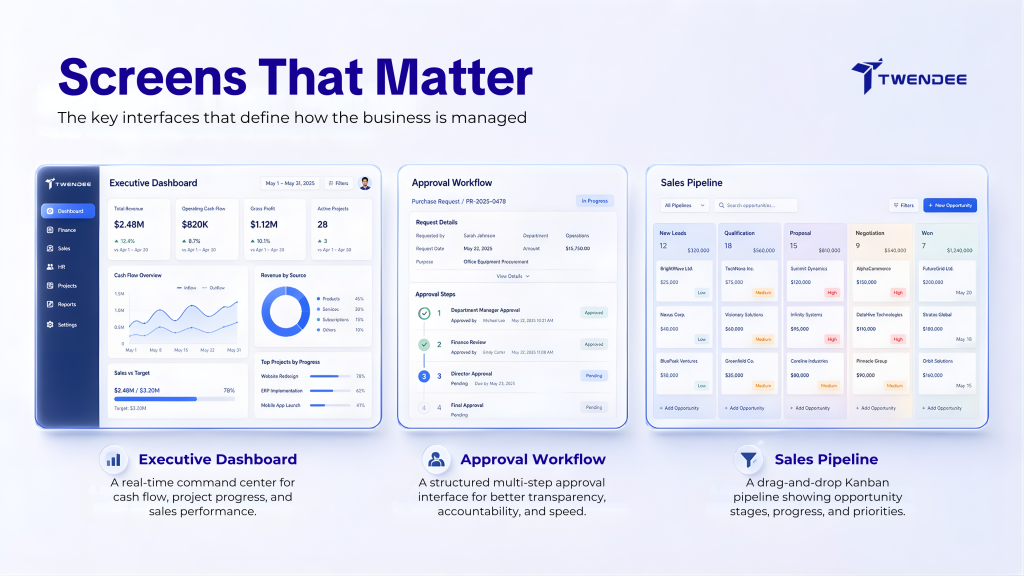
Finally, the company should capture the outcome. This includes the final decision, time taken, action completed, and business result.
This is where Twendee’s role becomes practical.
Twendee helps businesses identify operational gaps before scaling AI. The process begins by mapping how data, approvals, ownership, and actions move through the current workflow.
Twendee can then build systems that connect enterprise data, AI insights, and decision-making processes. Instead of leaving an AI recommendation inside an isolated dashboard, Twendee can integrate it into ERP, CRM, approval flows, internal requests, and operational platforms.
For example, an AI system may identify a delivery risk. The workflow can attach that insight to the correct project, assign an owner, request approval when the risk crosses a defined threshold, and record the final response.
The same approach can support customer risk, budget anomalies, supplier exceptions, inventory decisions, sales opportunities, and internal operational requests.
Twendee can also connect existing business systems so that decision owners receive the right context without collecting it manually.
The goal is not simply to generate insights faster.
It is to reduce the distance between insight and accountable action.
Conclusion
AI can accelerate analysis, but the organization still determines decision speed.
Decisions slow down when ownership is unclear, approval logic ignores risk, insights sit outside workflows, or outcomes are not tracked. Better dashboards alone cannot remove these bottlenecks.
Strong AI decision making connects information with decision rights, workflow logic, approvals, execution, and feedback.
Twendee helps businesses build that connection. By integrating AI insights into ERP, CRM, internal platforms, and operational workflows, Twendee helps teams move from faster information to clearer, more accountable, and more reviewable decisions.
Book a call: Calendly
Read latest blog: AI Workloads Are Breaking Old Cloud Cost Planning