

AI cost governance is becoming one of the hardest questions in enterprise AI. Companies are spending more on models, infrastructure, licenses, data pipelines, and agentic workflows, but many still cannot clearly explain which AI use cases are creating measurable business value. That gap is dangerous. When AI Costs Are Rising Faster Than Companies Can JustifyAI moves from pilot to daily operations, cost is no longer an innovation budget line. It becomes an operating discipline.
Why AI cost governance is becoming a board-level issue
Enterprise AI adoption is no longer slow or experimental. McKinsey’s 2025 State of AI survey found that 88% of organizations now use AI in at least one business function, up from 78% a year earlier. Deloitte’s 2026 State of AI in the Enterprise report also shows that worker access to AI rose by 50% in 2025, while the number of companies with at least 40% of AI projects in production is expected to double within six months. This sounds like progress, but it also changes the cost equation.
When AI is limited to pilots, spending is easier to tolerate. A few teams test tools, run proofs of concept, and treat the budget as innovation investment. But once AI expands across departments, cost becomes harder to track. The expense is no longer just a subscription fee. It includes inference usage, API calls, cloud infrastructure, data storage, model evaluation, integration work, security controls, workflow redesign, and ongoing monitoring. This is where many companies begin to lose visibility.
A marketing team may use AI for content production. Customer support may deploy AI assistants. Finance may test document automation. Sales may experiment with lead scoring. Operations may use AI to summarize requests or trigger workflows. Each use case may appear affordable on its own, but the combined cost can rise quickly when teams use different tools, models, and vendors without a shared governance layer.
The issue is not that companies should spend less on AI. In many cases, AI investment is necessary to stay competitive. The issue is that AI spending often grows faster than measurement discipline.
McKinsey’s research makes this gap clear. While AI adoption is widespread, only 39% of respondents report enterprise-level EBIT impact from AI. That means many organizations are using AI, but fewer can prove that AI is improving financial performance at the enterprise level.
This is exactly why AI cost governance matters. It forces companies to move beyond the basic question of “Are we using AI?” and ask harder questions:
- Which AI use cases reduce cost, increase revenue, improve quality, or reduce risk?
- Which use cases are consuming the budget without changing business outcomes?
- Which teams are using AI safely, and which workflows are creating hidden operational exposure?
Without this level of visibility, AI becomes difficult to defend. Leaders may see rising usage but unclear ROI. Finance may see growing vendor costs without a clear business case. IT may see more infrastructure demand without knowing which workflows are worth scaling. The result is a familiar enterprise pattern: enthusiasm rises first, then cost pressure follows. AI cost governance is the discipline that prevents that cycle from becoming waste.
The hidden cost of AI is not only models, but uncontrolled workflows
AI spending is often discussed as a model cost problem. Inference costs, token usage, infrastructure, and licensing are important, but they are only part of the picture. The deeper cost problem comes from how AI is embedded into workflows.
A simple AI assistant may be inexpensive when used occasionally. But an AI workflow that reads documents, retrieves internal data, calls multiple systems, generates outputs, requests approval, and updates records can become far more expensive. Every step adds cost. Every integration adds maintenance. Every automated action requires controls. This is why agentic AI changes the governance challenge.
Traditional software costs are usually easier to predict. A company pays for licenses, implementation, support, and infrastructure. AI agents introduce more variable cost because usage depends on task complexity, number of steps, model calls, tool access, and human review requirements. The same workflow may cost different amounts depending on how much data the agent retrieves, how many attempts it takes to complete a task, and whether it escalates to a human.
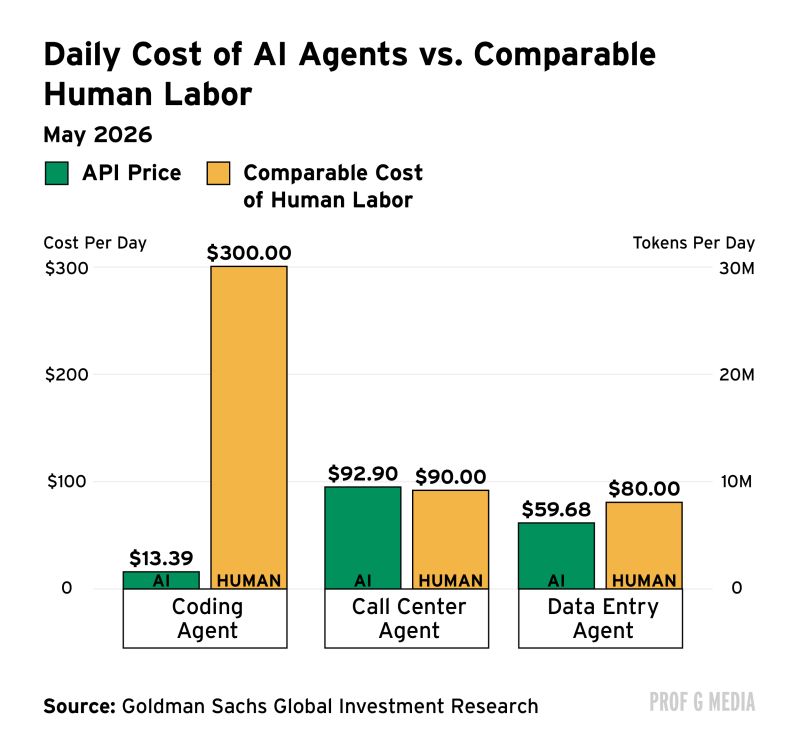
Gartner’s warning on agentic AI is especially relevant here. In its 2025 forecast, Gartner predicted that over 40% of agentic AI projects will be canceled by the end of 2027 due to escalating costs, unclear business value, or inadequate risk controls. Gartner also noted that many current agentic AI projects are early-stage experiments or proofs of concept driven by hype, which can blind organizations to the real cost and complexity of deployment. This does not mean agentic AI has no value. It means agentic AI needs stronger cost discipline than many companies currently apply.
A business may deploy an AI agent to handle internal requests. At first, the agent looks efficient because it reduces manual checking. But if the workflow is poorly designed, the agent may repeatedly retrieve unnecessary data, trigger too many approval steps, rely on expensive models for low-value tasks, or require frequent human correction. In that case, the company has not automated a process. It has created a costly and unstable operating layer.
The same risk appears in enterprise AI licensing. Teams may buy overlapping tools because each vendor promises productivity gains. But without usage control, cost allocation, and outcome tracking, the company cannot know whether those tools are replacing manual work or simply adding another layer to the tech stack. This is where AI cost management must go beyond procurement.
A useful AI cost model should connect three layers: usage, workflow, and business outcome. Usage shows how much AI is consumed. Workflow shows where AI is used inside operations. Business outcome shows whether that usage creates measurable value. For example, a support chatbot should not be measured only by the number of conversations handled. It should be measured by resolution rate, escalation reduction, response time improvement, customer satisfaction, and cost per resolved case. An AI document processing workflow should not be measured only by pages processed. It should be measured by reduced manual hours, error reduction, approval speed, and compliance reliability. The most expensive AI use case is not always the one with the highest invoice. It is the one that consumes resources without changing an important business metric.
How enterprises can make AI spending measurable and controllable
Effective AI cost governance starts before the AI system is deployed. It begins with use case selection. Not every workflow needs AI. Some workflows only need better automation. Some need cleaner data. Some need a more reliable internal system. Some need human decision-making supported by better visibility. AI becomes valuable when it is applied to a workflow where intelligence, prediction, language understanding, or decision support creates a measurable improvement. This is why enterprises should define the business metric before defining the AI tool.
- A good AI use case should be tied to a clear operational outcome: lower processing cost, faster approval cycle, fewer manual errors, higher conversion rate, better SLA compliance, or reduced support escalation. Without that target, AI cost becomes difficult to judge because usage rises without a defined success threshold.
- The second step is cost visibility. Companies need to know which teams, workflows, vendors, and models are driving AI spend. This is especially important when AI usage is embedded into products or internal systems. Without monitoring at the workflow level, leaders may only see the final cloud bill or vendor invoice, not the operational behavior behind it.
- The third step is usage control. AI systems should have clear boundaries around when they can act, which data they can access, which model they should use, and when human approval is required. A low-risk summarization task should not use the same expensive architecture as a high-risk financial workflow. A retrieval task should not call multiple systems if the required answer can be found in one trusted source.
- The fourth step is value review. AI cost governance should be treated as an ongoing operating process, not a one-time approval. Use cases should be reviewed against real outcomes. If an AI workflow reduces manual hours but increases exception handling, the net value may be lower than expected. If an AI agent improves speed but creates compliance risk, the business case may need to be redesigned.
This is where Twendee’s role becomes practical. Twendee helps companies design AI systems with cost visibility, workflow control, and business value in mind. Instead of building AI experiments that sit outside daily operations, Twendee focuses on AI workflows that connect to real business processes, such as ERP, CRM, internal approvals, customer operations, finance workflows, and reporting systems.
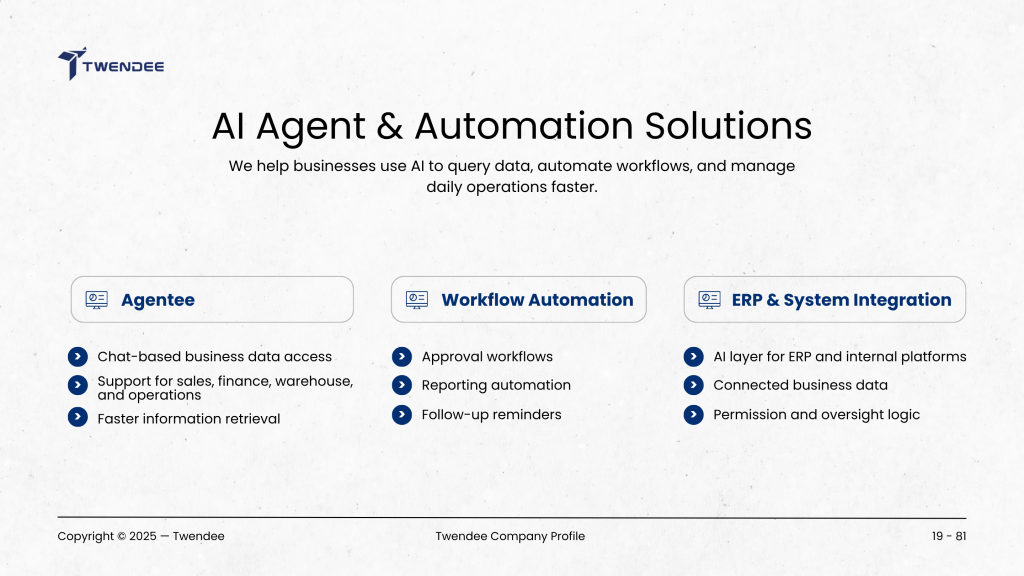
Twendee’s AI Agent & Automation Solutions are designed around controlled workflows, connected business data, and permission logic, helping companies move from scattered AI experiments to measurable operational use cases.
In practice, this means helping businesses define where AI should be used, where automation is enough, and where human approval must remain part of the process. It also means building systems that can track usage, structure permissions, connect AI actions to operational data, and measure whether the workflow creates value.
For enterprise teams, this approach matters because AI cost governance cannot live only in finance or IT. It has to be built into the workflow itself. A well-designed AI workflow should make several things visible: what the AI system is doing, which data it uses, how much it consumes, who approved the action, and what business outcome changed as a result. Without that structure, AI becomes hard to scale responsibly. With that structure, companies can invest more confidently because spending is tied to measurable operational impact.
This is also why custom internal systems and ERP-connected AI workflows are becoming more important. When AI is embedded into a controlled operating platform, companies can avoid uncontrolled experimentation across disconnected tools. They can define permissions, monitor usage, standardize workflows, and connect AI performance to real business metrics. AI spending will keep rising. The companies that benefit most will not be the ones that spend the most, but the ones that know exactly where AI creates value and where it does not.
Conclusion
AI costs are rising because enterprise adoption is expanding through tools, infrastructure, licenses, data systems, and agentic workflows. But higher spending does not automatically mean higher business value. The real challenge is whether companies can connect AI usage to measurable outcomes.
This is why AI cost governance is becoming a core requirement for enterprise AI. It helps companies control spending, prioritize valuable use cases, reduce waste, and avoid scaling AI workflows that look impressive but fail to improve operations.
Twendee supports this shift by helping companies build AI workflows with clear business logic, cost visibility, usage control, and operational measurement. Through ERP-connected systems, internal automation, and practical AI workflow design, Twendee helps businesses move from uncontrolled AI experimentation to AI systems that are built for measurable value.
To explore how Twendee helps businesses design practical AI workflows with better cost and usage control, visit Twendee Software or connect with the team on LinkedIn.
Read latest blog: Automation Breaks When Workflows Are Poorly Defined